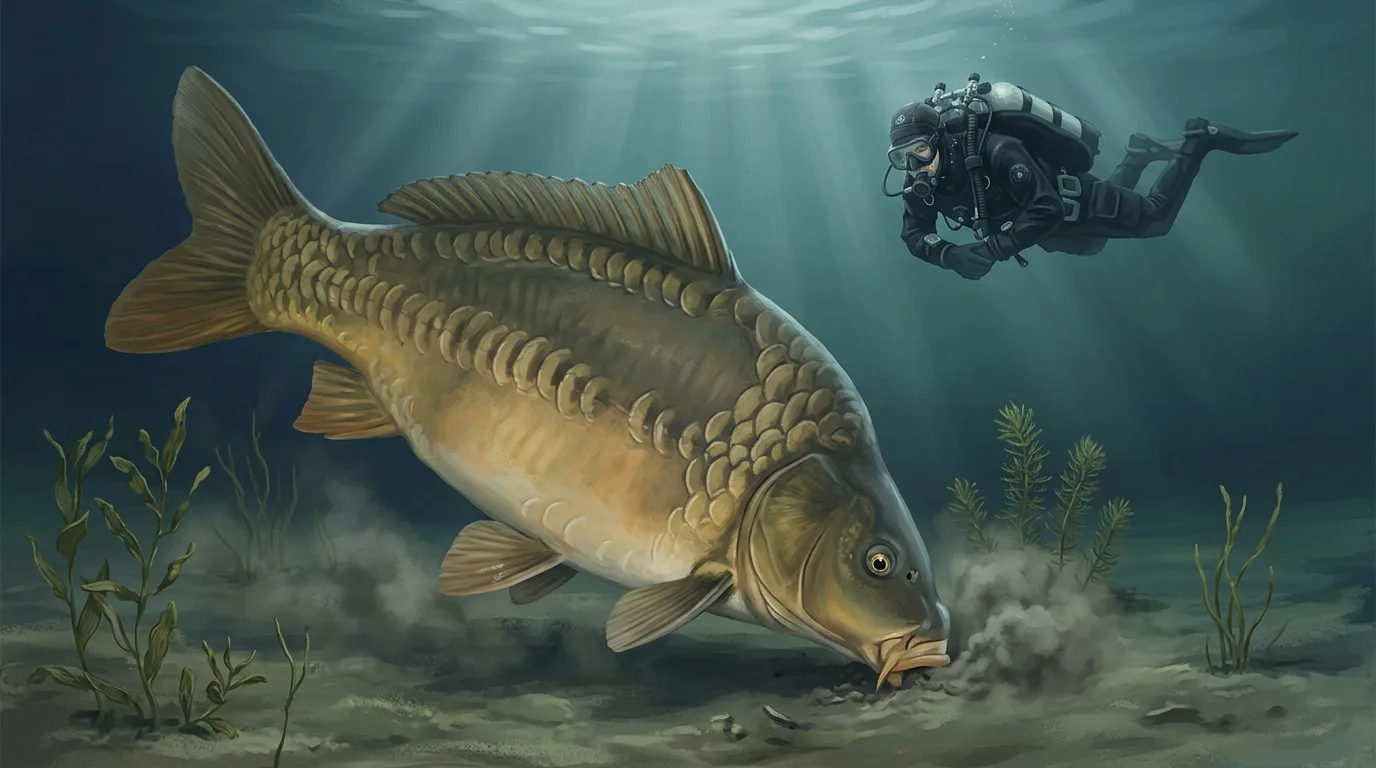
Say “carp” in Poland and most people picture a bathtub in a block of flats and a fish bought a week before Christmas Eve. A diver pictures something else: a heavy, unhurried shape hanging above the bottom of a flooded quarry, able to vanish in a single cloud of silt the moment it notices you. The carp has been in Poland for roughly eight hundred years, and it is also one of the best-studied fish in the world. It comes with legends of two-hundred-year-old individuals, a Supreme Court ruling and a place on the list of the hundred worst invasive species. It deserves a closer look.
At a glance
- The common carp (Cyprinus carpio) comes from the Black, Caspian and Aral Sea basins. It was probably brought to Poland from Bohemia and Moravia around 1200 and has been farmed in ponds ever since12.
- Fully scaled, mirror, leather and linear carp all belong to one species, and a simple two-gene model explains the differences in their scale patterns3. Koi descend from the Asian Amur carp, which some taxonomists treat as a separate species4.
- Carp feed by rooting in the bottom. At high densities they cloud the water and destroy plant beds, which is why the IUCN put them on its list of “100 of the world’s worst invasive alien species”567.
- In Polish open waters carp breed only sporadically, because they need warm water (about 18–20 °C) and flooded vegetation1.
- National rules set no minimum size or closed season for carp. Water managers such as the Polish Angling Association (PZW) set these in their own regulations89.
- Fish are vertebrates covered by Poland’s Animal Protection Act, and the Supreme Court has ruled that keeping carp out of water can amount to cruelty10.
Where carp come from
The wild carp, known in Polish as sazan, lives in the middle and lower reaches of rivers and in oxbow lakes of the Black, Caspian and Aral Sea basins, including the Danube2. Its body is long and fairly slim, quite unlike the stocky farmed carp. The Romans kept carp in storage ponds (piscinae) as a luxury food. In the Middle Ages monasteries took them over, since fish were needed for the many fast days. Unintentional domestication began between the 12th and mid-14th centuries, when the largest individuals were chosen for breeding. Controlled pond breeding only developed in the 19th century1112.
Carp most likely reached Polish lands around 1200 from Bohemia and Moravia1. Tradition credits the Cistercians with the first ponds. What is certain is that pond farming developed in Silesia, in the Barycz valley and in western Lesser Poland. Around Zator the ponds are several hundred years old, and today the area promotes itself as the Carp Valley (Dolina Karpia). Since 2011 “karp zatorski” (Zator carp) has been an EU Protected Designation of Origin, covering live carp from the municipalities of Zator, Przeciszów and Spytkowice13.
In Asia the story ran separately. Cyprinids have been farmed in China for more than two thousand years11. Some researchers treat the East Asian carp as a separate species, the Amur carp (Cyprinus rubrofuscus). Koi descend from it, and systematic breeding of the coloured varieties began in the 19th century in Japan’s Niigata prefecture4.
Scaled, mirror, leather: one species, different scales
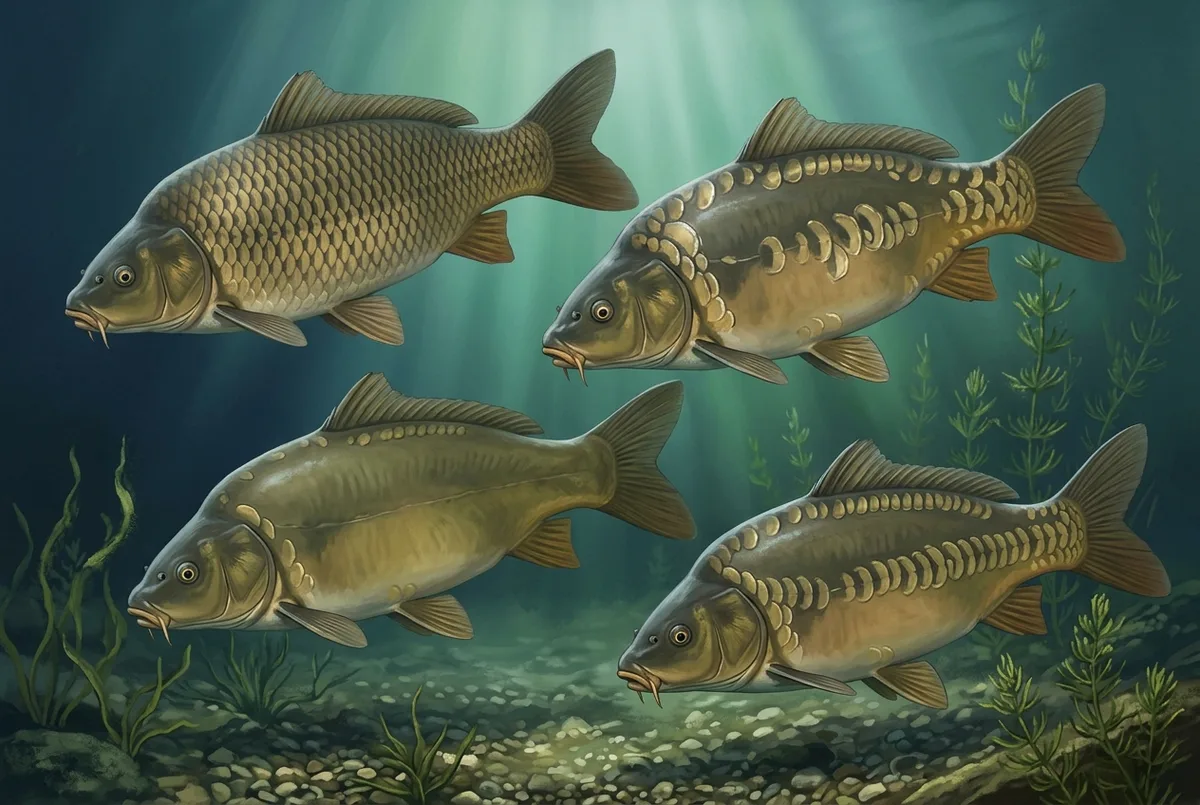
Farmed carp differ above all in their scales:
- fully scaled (common) carp have scales all over the body, like the wild fish;
- mirror carp have a few large, shiny, irregularly scattered scales, usually along the back and the lateral line;
- linear carp have a single neat row of large scales along the lateral line;
- leather carp are almost completely naked.
The Russian geneticist Valentin Kirpichnikov explained these patterns with two genes, named S and N. The S gene later turned out to be a variant of fibroblast growth factor receptor 1 (fgfr1a1). A double dose of the N allele is lethal, which is why a true-breeding line of linear carp cannot be established3. Koi, by contrast, are mainly colour varieties, and their colours are the result of many generations of selection.
Telling carp from crucian carp and grass carp
The easiest way to recognise a carp is by the two pairs of barbels at the corners of the mouth (the shorter pair sits on the upper lip) and the long dorsal fin, whose first ray is a stiff, serrated spine11. The crucian carp (Carassius carassius) and the Prussian carp (C. gibelio) have a similarly long dorsal fin but no barbels, and they are much smaller. The grass carp (Ctenopharyngodon idella) has a log-shaped body, a short dorsal fin, large dark-edged scales and no barbels either. Carp hybridise readily with crucian carp, so fish with intermediate features, with very short barbels or none at all, turn up in the wild.
Biology: a rooting omnivore
Carp have no teeth in their jaws. They crush food with pharyngeal teeth set in three rows on each side (formula 1.1.3–3.1.1). These are massive, with flat, molar-like crowns211. The protrusible mouth works like a vacuum cleaner: the carp sucks in mud, keeps insect larvae, worms, mussels and snails, and expels the rest through its gills. It also eats seeds and plant material. In farm ponds it readily takes grain, and the whole carp-farming industry depends on this11.
This way of feeding affects the whole water body. A rooting carp stirs up sediment, releases phosphorus from it and pulls plants out by the roots. The water turns murky, algae thrive and underwater vegetation retreats. A 2009 review by Weber and Brown describes the carp as a fish that changes an ecosystem from below (nutrients, turbidity) and from above (eating invertebrates) at the same time6. In a lake in Minnesota, an increase in carp biomass from about 30 to about 100 kg/ha coincided with roughly a halving of plant cover and waterfowl numbers7. A meta-analysis of experimental studies shows, however, that the damage threshold depends on the type of water body and on what is being measured14. This “engineering” effect earned the carp a place on the list of the world’s 100 worst invasive alien species, compiled by the IUCN’s Invasive Species Specialist Group (ISSG)5. In Poland, the Institute of Nature Conservation of the Polish Academy of Sciences classes it as an alien, potentially invasive species. It notes that at high densities carp speed up the eutrophication of natural waters and compete with native bottom-feeding fish1.
Warmth-loving and tough
Carp grow best at water temperatures of 23–30 °C but survive freezing winters. They also tolerate very low oxygen levels (as little as 0.3–0.5 mg/l)11. FishBase gives a temperature range of 3 to 35 °C2. In winter carp gather in deeper spots and barely feed. In spring they return to the shallows, which warm up first.
Spawning: why it rarely succeeds in Poland
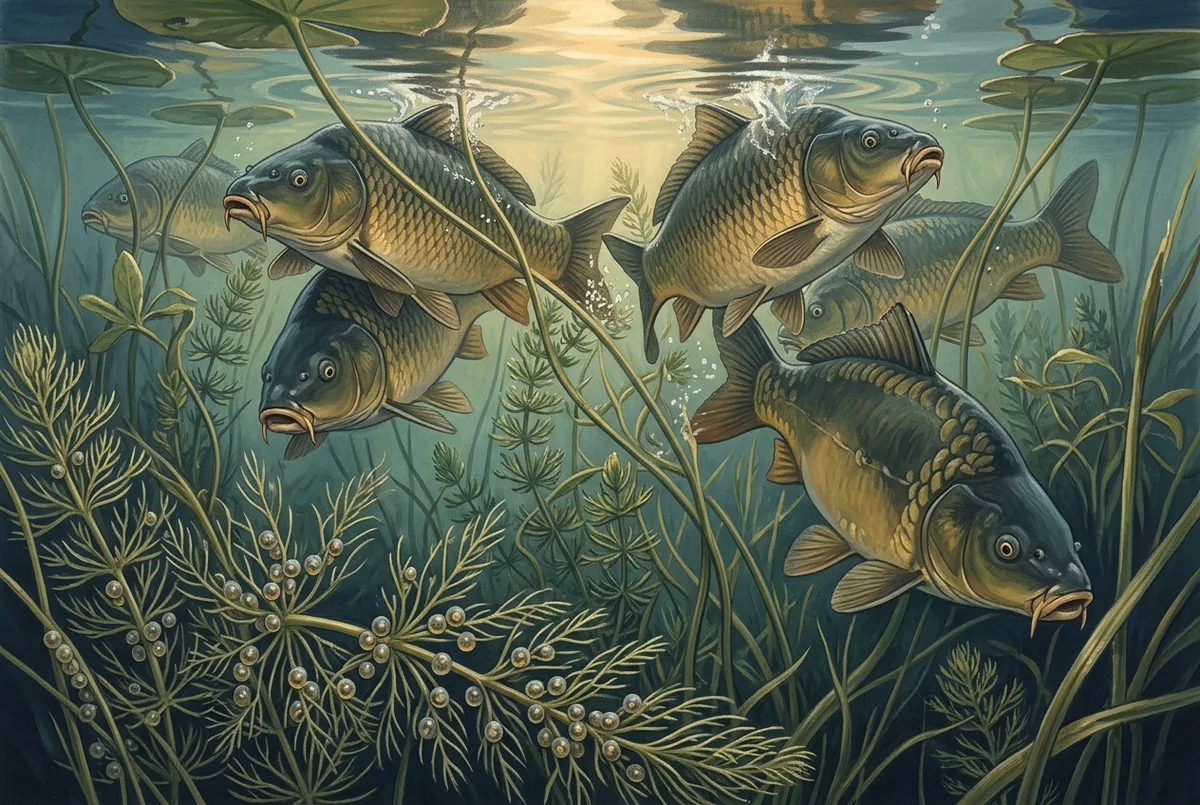
European carp begin to spawn once the water reaches 17–18 °C11. In Poland this usually happens in late May and June, at 18–20 °C1. Carp spawn on plants, ideally on freshly flooded grass along the shore. A female can lay more than a million eggs in a season2. The sticky eggs cling to vegetation, and the embryos develop in about three days at 20–23 °C11.
So carp need warmth, shallow flooded vegetation and a stable water level all at once, and Polish lakes and rivers rarely offer all three together. As a result, carp breed only sporadically in Polish open waters1. Most carp in lakes, reservoirs and quarries have been stocked by the people who manage those waters. In very warm summers, however, especially in shallow water bodies, spawning can succeed.
Growth, age and records
In temperate-zone ponds carp reach 1–2 kg after two to four seasons11. The usual length is about 30 cm, the maximum recorded is 129 cm, and the heaviest fish in the FishBase database weighed 40.1 kg2.
Age. FishBase gives a maximum of 38 years2. In 2025 Canadian researchers used otoliths (ear stones) to age carp from lakes in Saskatchewan at 3–53 years15. Mark-and-recapture studies, however, have validated ages only up to 14 years. A review of carp ageing methods notes that reports of exceptionally old carp are mostly anecdotal and concern fish kept in captivity16.
Hanako, the legend. The most famous of these anecdotes concerns Hanako, a Japanese koi that died in 1977 and was supposedly 226 years old. Her age was worked out by counting growth rings on her scales. The result was never published in a peer-reviewed journal, and scales are considered the least accurate way to age a carp1716. A few decades is realistic for a carp. Two hundred years remains a legend.
Records. The official list of Polish records is kept by Wiadomości Wędkarskie, the Polish Angling Association’s magazine. Since October 2024 the record has been a 39.60 kg carp caught by Karol Chojecki in Lake Miłoszewskie in Kashubia18. Worldwide, two things need to be kept apart. The IGFA (International Game Fish Association) all-tackle record has stood since 1987: a 34.33 kg (75 lb 11 oz) fish from France caught by Leo van der Gugten. Much heavier fish are caught at private, heavily stocked and fed commercial venues, which the IGFA does not recognise. In 2024 Polish angler Kacper Stępień landed a 104.5 lb (about 47.4 kg) carp at the Euro Aqua fishery in Hungary19. According to the carp-angling community, a 49.5 kg fish was caught at the same venue in May 202620. These are commercial-fishery records, not records from wild populations.
Carp in culture: Christmas Eve, communist Poland and a scale in your wallet
A popular story says that carp for Christmas Eve was “invented” in 1947 by the communist minister Hilary Minc with the slogan “a carp on every Christmas Eve table”. Fact-checkers, however, found no trace of that slogan in the press of the time or in Minc’s speeches, and no decree in the official journals of laws21. Carp was on Polish tables much earlier. The Compendium Ferculorum of 1682, the oldest Polish cookbook, already contains carp recipes, and in the 19th century carp became a festive dish for town dwellers2122. What communist Poland can be credited with is something else. After the war, with the Baltic fishing fleet in ruins, cheap pond-raised carp became the most accessible fish and pushed pike, zander and salmon off the Christmas Eve table2321.
Keeping a scale from the Christmas Eve carp in your wallet to bring money in the new year is a folk superstition of unclear origin. It most likely comes from the way a shiny scale resembles a coin.
Welfare: a carp is a vertebrate
Poland’s Animal Protection Act covers all vertebrates, fish included. In its judgment of 13 December 2016 (case II KK 281/16), the Supreme Court held that keeping live carp in crates without water before Christmas and handing them to customers in plastic bags can amount to animal cruelty. A carp breathes through its gills and needs water, and suffering being reversible does not rule out cruelty10. The ruling does not ban the sale of live fish. It does set a standard: fish must be kept and transported in water and killed quickly by someone who knows how to do it. More and more people simply buy their carp already prepared.
Rules: what the law says
Since 27 July 2023 the governing act has been the Regulation of the Minister of Agriculture and Rural Development of 12 July 2023 on detailed conditions for the protection and catching of fish in inland surface waters (Journal of Laws 2023, item 1373). It replaced the earlier regulation of 2001 and its consolidated text of 2018. Carp does not appear on the list of species with a minimum size or a closed season8.
Those who manage fishing districts may, however, introduce their own stricter rules, and they commonly do. In the PZW Bielsko-Biała district, from 1 January 2026, carp on the Tresna and Porąbka reservoirs are protected up to 35 cm and above 65 cm. This means only fish within that slot may be kept, and the daily limit is 2 carp and tench combined, with no more than 20 a year9. Other districts use different values, and commercial fisheries often run on a no-kill basis: every fish must be returned, usually after unhooking on a mat and using a landing net. Always check the rules for the specific water before you go.
| National rules (Journal of Laws 2023, item 1373) | Example: PZW Bielsko-Biała 2026, Tresna and Porąbka | |
|---|---|---|
| Protected size | none | up to 35 cm and above 65 cm |
| Closed season | none | none |
| Daily limit | none | 2 fish (carp and tench combined) |
Meeting carp underwater
Carp can be found in many lakes, reservoirs and flooded quarries. They are most often seen in the shallows and along grassy slopes from late spring to autumn, when the water is warm. Where they are fished, they tend to be shy: they notice a diver from a distance and swim off, leaving a trail of murky water behind. At some dive sites where fish are fed, carp are almost tame and come up on their own, sometimes within arm’s reach.
A few rules that help both us and the fish:
- Keep your trim and your distance. A carp rooting in the bottom is the best moment to watch. Hover a few metres away, don’t sink onto the bottom and don’t kick up silt with your fins. The fish will often go back to feeding.
- Don’t chase or cut it off. A frightened carp bolts, and the diver is left in zero visibility.
- Don’t feed. Bread and bait pollute the water, and fish used to people become easy prey and pester other divers.
- Don’t touch. Mucus protects a fish’s skin from infection, and rubbing it off opens the way to fungi and bacteria.
- Avoid spawning grounds. In late spring, shallow, weedy bays with splashing carp are spawning grounds. Stay out of them.
- Read the bottom. Pits and furrows in the mud, uprooted plants and bands of cloudy water are traces of feeding carp, and they help you “read” a lake.
It is easy to be indifferent to carp, since “it’s only a carp”. Underwater it turns out to be a cautious, intelligent and highly influential resident of the lake. It is worth watching it a little longer before it ends up in a bathtub again.
Footnotes
-
Institute of Nature Conservation, Polish Academy of Sciences. Cyprinus carpio Linnaeus, 1758 — common carp. “Alien species in Poland” database. https://www.iop.krakow.pl/ias/gatunki/206 (accessed 30.09.2026). ↩ ↩2 ↩3 ↩4 ↩5 ↩6
-
Froese R., Pauly D. (eds). Cyprinus carpio Linnaeus, 1758 — Common carp. FishBase. https://www.fishbase.se/summary/Cyprinus-carpio.html (accessed 30.09.2026). ↩ ↩2 ↩3 ↩4 ↩5 ↩6 ↩7
-
Casas L., Szűcs R., Vij S., Goh C.H., Kathiresan P., Németh S. et al. Disappearing scales in carps: re-visiting Kirpichnikov’s model on the genetics of scale pattern formation. PLoS ONE. 2013;8(12):e83327. doi:10.1371/journal.pone.0083327. ↩ ↩2
-
U.S. Fish and Wildlife Service. Koi (Cyprinus rubrofuscus) Ecological Risk Screening Summary. https://www.fws.gov/sites/default/files/documents/Ecological-Risk-Screening-Summary-Koi.pdf (citing Kottelat M., Freyhof J. Handbook of European Freshwater Fishes. 2007). ↩ ↩2
-
Lowe S., Browne M., Boudjelas S., De Poorter M. 100 of the World’s Worst Invasive Alien Species. A selection from the Global Invasive Species Database. Invasive Species Specialist Group (ISSG) SSC IUCN, 2000. https://portals.iucn.org/library/sites/library/files/documents/2000-126.pdf. ↩ ↩2
-
Weber M.J., Brown M.L. Effects of common carp on aquatic ecosystems 80 years after “Carp as a dominant”: ecological insights for fisheries management. Reviews in Fisheries Science. 2009;17(4):524–537. doi:10.1080/10641260903189243. ↩ ↩2
-
Bajer P.G., Sullivan G., Sorensen P.W. Effects of a rapidly increasing population of common carp on vegetative cover and waterfowl in a recently restored Midwestern shallow lake. Hydrobiologia. 2009;632:235–245. doi:10.1007/s10750-009-9844-3. ↩ ↩2
-
Rozporządzenie Ministra Rolnictwa i Rozwoju Wsi z dnia 12 lipca 2023 r. w sprawie szczegółowych warunków ochrony i połowu ryb w powierzchniowych wodach śródlądowych [Regulation of the Minister of Agriculture and Rural Development of 12 July 2023]. Journal of Laws 2023, item 1373 (§ 6–7). https://isap.sejm.gov.pl/isap.nsf/DocDetails.xsp?id=WDU20230001373 (in Polish). ↩ ↩2
-
PZW Bielsko-Biała District. Regulamin połowu ryb w wodach ogólnie dostępnych [Fishing rules for public waters], as of 1.01.2026. https://bielsko-biala.pzw.pl/brepo/panel_repo/2025/12/27/xjzoxn/rapr-okreg-bielsko-biala.pdf (in Polish). ↩ ↩2
-
Judgment of the Supreme Court of Poland of 13 December 2016, case II KK 281/16. Summary (in Polish): Institute of Psychology, Polish Academy of Sciences, 15.12.2016. https://psych.pan.pl/pl/sad-najwyzszy-wydal-wyrok-w-sprawie-dotyczacej-znecania-sie-nad-karpiami/. ↩ ↩2
-
Peteri A. Cyprinus carpio. In: Cultured Aquatic Species Fact Sheets. FAO, 2009. https://www.fao.org/fishery/docs/DOCUMENT/aquaculture/CulturedSpecies/file/en/en_commoncarp.htm. ↩ ↩2 ↩3 ↩4 ↩5 ↩6 ↩7 ↩8 ↩9
-
Balon E.K. Origin and domestication of the wild carp, Cyprinus carpio: from Roman gourmets to the swimming flowers. Aquaculture. 1995;129:3–48. doi:10.1016/0044-8486(94)00227-F. ↩
-
Commission Regulation (EU) No 485/2011 of 18 May 2011 entering a name in the register of protected designations of origin and protected geographical indications [Karp zatorski (PDO)]. Official Journal of the EU, 20.05.2011. Summary (in Polish): prawo.pl, “Karp zatorski chronioną nazwą pochodzenia w UE”, 2011. https://www.prawo.pl/prawnicy-sady/karp-zatorski-chroniona-nazwa-pochodzenia-w-ue,38478.html. ↩
-
Vilizzi L., Tarkan A.S., Copp G.H. Experimental evidence from causal criteria analysis for the effects of common carp Cyprinus carpio on freshwater ecosystems: a global perspective. Reviews in Fisheries Science & Aquaculture. 2015;23(3):253–290. doi:10.1080/23308249.2015.1051214. ↩
-
Lackmann A.R., Sereda J., Villeneuve J. et al. Within-ecosystem comparison of bigmouth buffalo Ictiobus cyprinellus and common carp Cyprinus carpio reveals diverging population trajectories, declining recruitment, and a lifespan of 148 years. Ecology and Evolution. 2025;15(11):e72483. doi:10.1002/ece3.72483. ↩
-
Vilizzi L. Age determination in common carp Cyprinus carpio: history, relative utility of ageing structures, precision and accuracy. Reviews in Fish Biology and Fisheries. 2018;28:461–484. doi:10.1007/s11160-018-9514-5. ↩ ↩2
-
Dapcevich M. Did World’s Oldest Fish “Hanako” Live To Be 226 Years Old? Snopes, 11.04.2021. https://www.snopes.com/fact-check/worlds-oldest-fish-hanako/. ↩
-
Wiadomości Wędkarskie (PZW). Karp 39,60 kg (105 cm) — nowy rekord Polski — Karol Chojecki. https://wiadomosciwedkarskie.com.pl/szczegoly-artykulu/karp-3960-kg-105-cm-nowy-rekord-polski-karol-chojecki_hDyemCCznblsVfzmKz4Y (in Polish). ↩
-
McNally B. Polish Angler Catches “Unimaginable” World-Record Sized Carp. Outdoor Life, 17.09.2024. https://www.outdoorlife.com/fishing/polish-angler-world-record-sized-car/. ↩
-
Carp Austria. 49.5 kg common carp from Euro-Aqua (updated 7.06.2026). https://carp-austria.com/en/world-record-carp-109lb-euro-aqua-2026/ (community site, not independently verified). ↩
-
Jaźwiński P. Karpia na Wigilię wymyślili komuniści? Jan III Sobieski miałby inne zdanie [Did the communists invent Christmas Eve carp? King John III Sobieski would disagree]. Konkret24 (TVN24), 24.12.2019. https://konkret24.tvn24.pl/polska/karpia-na-wigilie-wymyslili-komunisci-jan-iii-sobieski-mialby-inne-zdanie-ra994847-ls5792041 (in Polish). ↩ ↩2 ↩3
-
Zadroga M. Karp na wigilijnym stole wymysłem PRL? Sprawdzamy [Is Christmas Eve carp an invention of communist Poland? We check]. Fakenews.pl, 24.12.2020 (updated 12.08.2021). https://fakenews.pl/spoleczenstwo/karp-na-wigilijnym-stole-wymyslem-prl-sprawdzamy/ (in Polish). ↩
-
Karp na każdym wigilijnym stole, czyli jak to z tą tradycją było [A carp on every Christmas Eve table: the story of a tradition]. Dzieje.pl (PAP), 22.12.2018. https://dzieje.pl/rozmaitosci/karp-na-kazdym-wigilijnym-stole-czyli-jak-z-ta-tradycja-bylo (in Polish). ↩