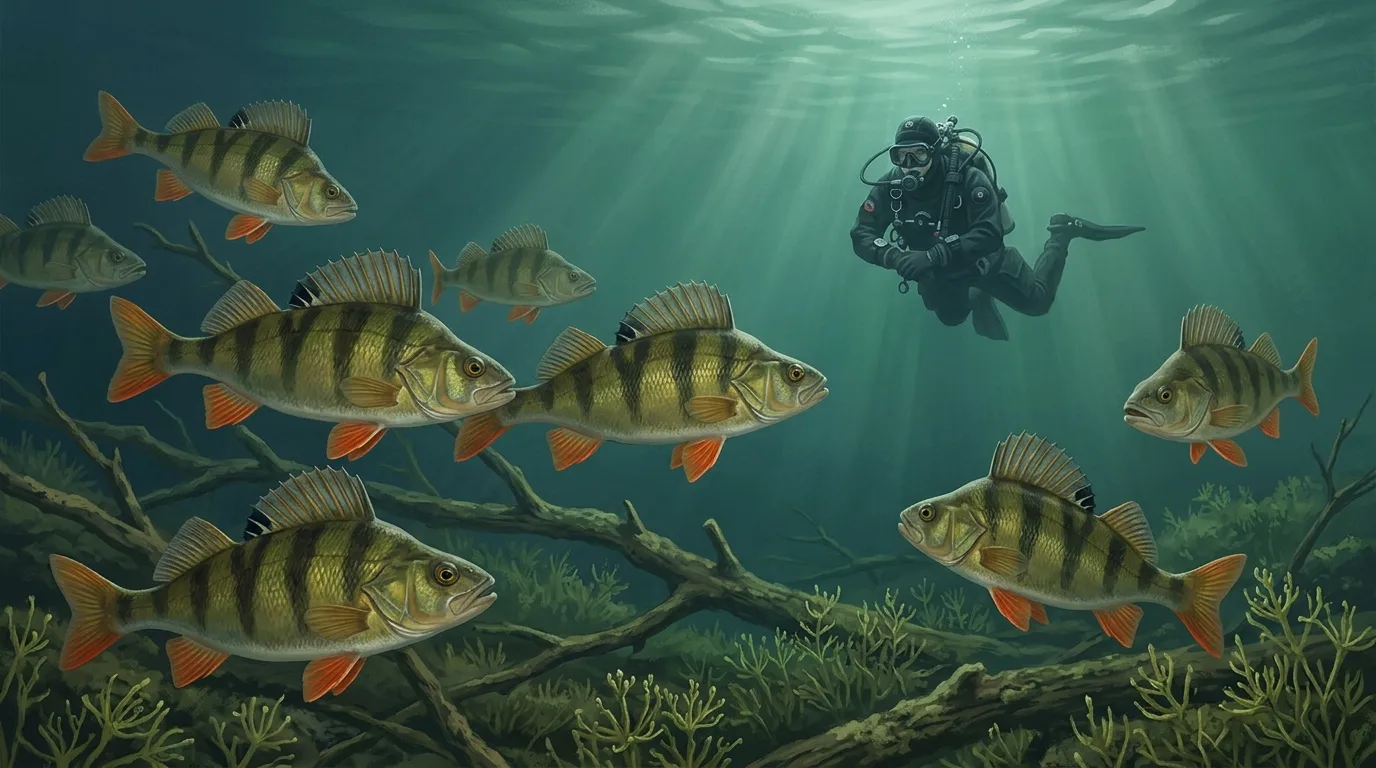
Anyone who has dived in a Polish lake or flooded quarry has almost certainly seen one. Striped, red-finned, with a spiky crest raised on its back, it hangs in the water a few metres in front of your mask and studies the diver as closely as the diver studies it. The perch is such an ordinary fish that it is easy to stop noticing it. That is a pity, because it is one of the most interesting inhabitants of our waters: a predator that hunts in groups, is often a cannibal, can stay a dwarf all its life or grow into a giant, and in spring leaves lacy ribbons of eggs on branches that are well worth seeing with your own eyes.
In brief
- The European perch (Perca fluviatilis) belongs to the perch family, Percidae. Its closest relatives in Poland are the zander and the ruffe1.
- You can recognise it by its 5–8 dark vertical bars, red or orange pelvic and anal fins, and a spiny first dorsal fin with a dark blotch at its rear end1.
- It hunts mainly by day, often in groups. Large perch readily eat smaller perch, which shapes the whole population23.
- In spring, females lay their eggs as long, whitish ribbons on plants and branches1. This is one of the best things a diver can watch.
- The Polish record is 2.76 kg and 52 cm (Lake Głębokie, 2025)4. National regulations set no minimum size or closed season for perch, but Polish Angling Association (PZW) rules usually do56.
The perch and its family
Percids (Percidae) are fish with two dorsal fins: a front one with hard, prickly spines and a soft rear one. In Polish waters you will commonly meet three members of the family. The perch is the most adaptable and the most numerous. The zander (Sander lucioperca) is larger and slimmer, has fangs and sees better in dim light7. The ruffe (Gymnocephalus cernua) is a small, slimy cousin with joined dorsal fins that keeps close to the bottom.
The Czarna Orawa catchment (the only sizeable part of Poland draining into the Danube) was once reported to hold the zingel (Zingel zingel) and the streber (Zingel streber) as well. According to the management plan for the Czarna Orawa Natura 2000 site, their occurrence there is now only of historical significance8. Two other Danubian percids, Balon’s ruffe (Gymnocephalus baloni) and the schraetzer (G. schraetser), live in the Danube basin (Balon’s ruffe also in the Dnieper), and FishBase does not list Poland within their range9.
Appearance and identification
The perch is hard to confuse with any other fish. It has a deep, laterally compressed body, and large individuals develop a distinct “hump” behind the head. The back is dark green or olive, the flanks greenish-gold and the belly pale. The flanks usually carry five to eight dark vertical bars. The pelvic and anal fins are yellow to red, and the tail fin is often reddish too1.
The most distinctive feature is the first dorsal fin: clearly taller than the second, with hard spines and a dark blotch near its rear end1. FishBase gives a total of 14–20 dorsal spines. When a perch is alarmed or about to strike, it raises this fin like a crest. The spines on the gill cover are sharp too, as anyone who has handled a perch quickly discovers.
Its colouring is not fixed. Finnish researchers compared perch from lakes with different water clarity. In the clearest lake the fish had the palest bellies, perch in the shallow littoral zone were more colourful than those in open water, and males had more brightly coloured bellies than females. In dark, humic lakes these differences were almost absent10. So a diver in a clear quarry will usually see contrasting, colourful perch, while in a brown forest lake they look greyer and duller.
Where it lives
The perch occupies a very wide range of habitats: lakes of every type, reservoirs, ponds, medium-sized rivers and even the brackish coastal bays of the Baltic1. It does best in water of 10–22 °C11. Young fish usually stay in the shallows, among plants and sunken branches. Large individuals more often patrol slopes, drop-offs and open water.
It really is a common fish. In a study by Poland’s Inland Fisheries Institute of the lower reaches of 19 tributaries of the lower Vistula, perch made up the largest share of the catch (16.3% of all fish caught), ahead of roach and white bream12. In lakes and quarries it is one of the fish divers see most often.
The perch is also relatively tolerant of acidified water, more so than roach. In acidified lakes in Norway, perch were most abundant where roach were scarce13. That tolerance has limits, though. In the most acidic small lakes of southern Finland, perch eggs died almost entirely, the populations aged, and in one lake perch were close to extinction14.
A hunter's eyes
The perch hunts by sight. It is a daytime predator, most active at dawn and dusk1. Its retina has cones sensitive to green and red light, so it sees colour7. The zander has a reflective layer behind the retina (tapetum) and, according to the same study, roughly twice the visual sensitivity of a similar-sized pike, so it copes better in dim light. This feature set the zander apart from all the species studied. The perch is therefore above all a hunter of daylight and dusk, while in darkness its larger cousin has the upper hand.
What it eats and how it hunts
A perch’s diet changes as it grows. Larvae eat tiny zooplankton, juveniles switch to invertebrates living on the bottom and on plants (insect larvae, freshwater shrimps, water lice), and adult perch often start eating fish once they reach about 12 cm1. The menu also includes fish eggs, crayfish and other crustaceans11.
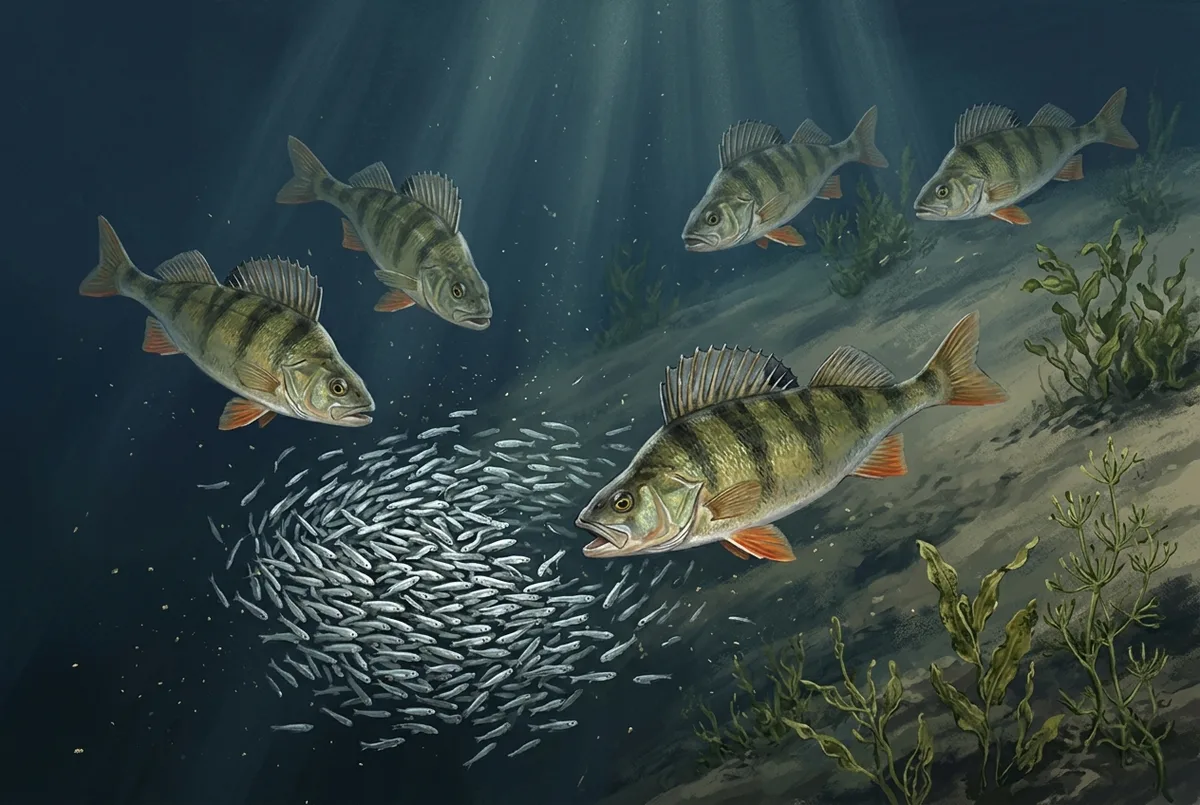
Perch often hunt in groups. Divers see several fish surround a shoal of fry and take turns darting into the cloud of prey. The Swedish ecologist Peter Eklöv tested in a pond experiment whether this pays off. He compared perch, which actively search for prey and live in schools, with pike, which ambush from cover and defend territories. The predators were kept singly or in fives, with the same number of prey. The growth of both species matched their strategies: for the social perch, the company of other perch helps hunting, while for the solitary pike competition gets in the way15.
Cannibals and dwarfs
The perch does not spare its own kind. Large individuals eat younger year classes while also competing with them for the same food (zooplankton and invertebrates). A Swedish team led by Lennart Persson showed that this mix of cannibalism and competition drives cyclical swings in the whole population2.
This explains two pictures familiar to anglers and divers. Many waters hold plenty of stunted perch: adult, sexually mature fish only a dozen or so centimetres long that fail to grow for years because they eat each other’s food. In other waters, or in the same lake a few years later, giant perch appear, fish that managed to switch to eating fish and now feed mainly on smaller perch. In a ten-year study of a Swedish lake, the population switched from a “stunted” phase to a “giant cannibal” phase and back, and these switches changed the amount of zooplankton and algae in the entire lake3. Whether a perch ends up a dwarf or a giant is therefore decided not only by its “genes” but by whether it manages to move from invertebrates to fish at the right moment in its life.
Spawning: ribbons of eggs on branches
Perch spawn in spring, when the water warms to about 7–8 °C1. In Poland this usually falls in April or May, later in cold, deep lakes. Males arrive at the spawning grounds first, and a female usually spawns accompanied by several males1.
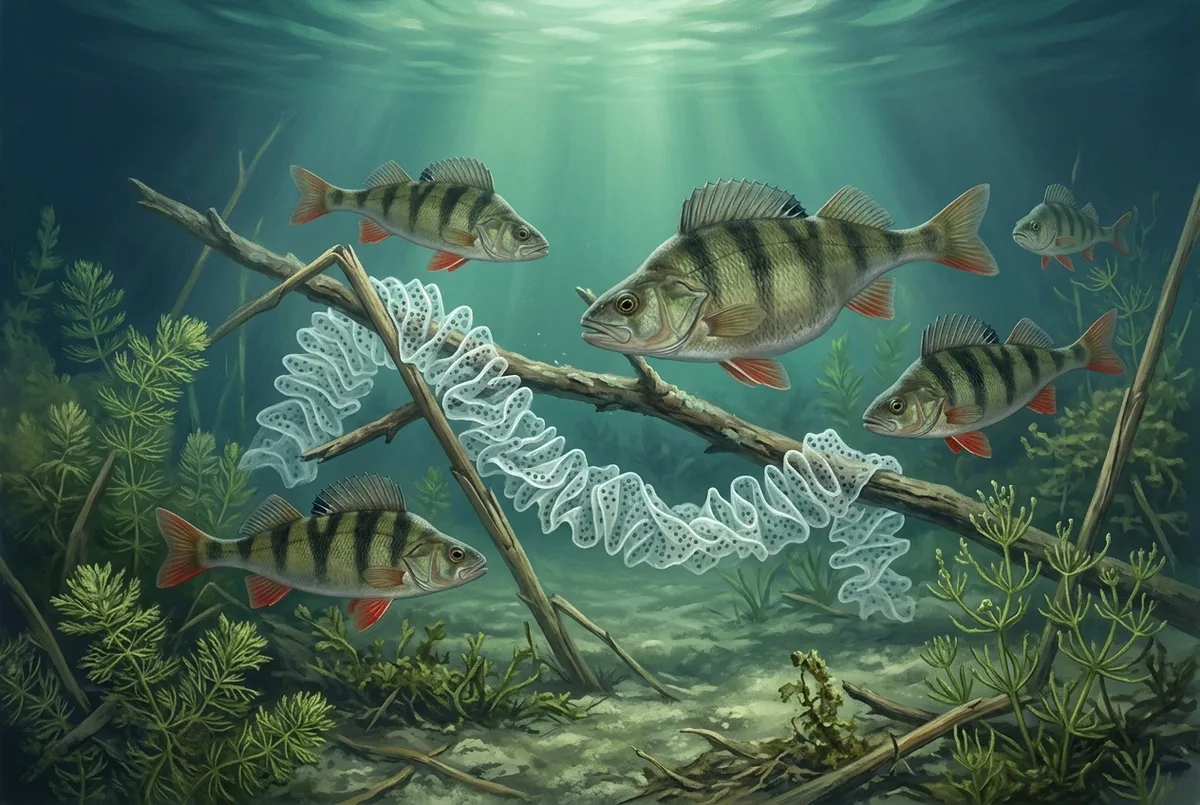
Perch spawn looks quite unlike that of most of our fish. It is not a scattering of single grains but a long, gelatinous, whitish ribbon, folded like an accordion and resembling lace or netting. It can be up to a metre long1. The female drapes it over sunken branches, roots, reeds or water plants. A single ribbon can hold up to 200,000 eggs11. Development takes about 8–16 days, depending on temperature1.
For a diver, this is one of the most beautiful sights in a spring lake. The ribbons are large and pale and usually hang shallow, a few metres down. A description of dives at Zakrzówek mentions exactly these “white, winding, broad ribbons of eggs” laid by perch under the platforms16. The eggs are delicate, however, and other fish wait for them on the spawning grounds. A cloud of silt kicked up by a fin, or the urge to “tidy” a ribbon, is enough to destroy it. We explain below how to behave near a spawning site.
Growth, age and records
A typical perch is about 25 cm long1. Sources differ on the age of maturity: according to GISD, males usually mature at one year and females at two11, while FishBase gives 2–4 years for both sexes1. In cold water and with poor growth it takes longer. The oldest known perch were 22 years old (Sweden)11. FishBase gives a maximum length of 60 cm and weight of 4.8 kg1, but these are literature figures rather than verified catches.
Angling records are more modest. The Polish record belongs to Zbigniew Czarny, who on 30 October 2025 caught a perch of 2.76 kg and 52 cm in Lake Głębokie (Lubusz Voivodeship). The fish also set the record in the length category and was returned to the water. The previous record, 2.69 kg, had been held since 2011 by Grzegorz Wieczorek4. The IGFA world record is 2.9 kg: a perch caught on 4 September 2010 by Kalle Vaaranen at Kökar in the Åland Islands (Finland)17.
Curiosities
Perch on tranquillisers. In 2013, Swedish scientists described an experiment in Science in which perch from natural populations were kept in water containing oxazepam, an anti-anxiety drug from the benzodiazepine group. At 1.8 micrograms per litre the fish became more active, less social and fed faster18. The study made headlines as evidence that drug residues in wastewater can change the behaviour of wild animals. The sequel is worth knowing. When some of the same researchers added oxazepam to a whole lake, at concentrations more than 200 times higher than those reported in European rivers, perch in their familiar environment did not become bolder. If anything they behaved more cautiously, and the effect of the drug proved small compared with other factors such as temperature and shoal dynamics19. It is a good example of how a laboratory result does not always carry straight over to a lake.
A research workhorse. The perch is common, widespread and well studied, so it is often used in ecological and ecotoxicological research, from acidification14 to pharmaceutical pollution18.
Myths and half-truths
“Perch are trash fish that always stay small.” Stunted populations exist, but they are not a trait of the species. They result from competition and a lack of suitable food at a key point in life. The same lakes can produce giant perch a few years later3.
“Perch have venomous spines.” The spines of the dorsal fin and gill cover are sharp and easily cause cuts, but the perch is not described in the literature as a venomous fish. The pain comes from the prick itself, and the wound can become inflamed like any cut received in water, so it is worth disinfecting.
“Perch are always green and yellow.” Their colouring depends on water clarity, habitat and even sex10.
Regulations: minimum size, closed season, bag limits
Nationwide rules for fishing in Polish inland waters are currently set by the Regulation of the Minister of Agriculture and Rural Development of 12 July 2023 on detailed conditions for the protection and fishing of fish in inland surface waters (Journal of Laws 2023, item 1373), which replaced the previous regulation of 2018. Perch appears in it neither among the species with a protected size nor among those with a closed season5. By comparison, zander has a protected size of 45 cm and a closed season from 1 March to 31 May.
That does not mean perch can be caught without limits. Fishery rights holders, including the regional districts of the Polish Angling Association (PZW), set their own rules in their amateur fishing regulations (RAPR), which are often stricter than the national regulation. For example, in the PZW Ciechanów District in 2026 perch have a protected size of “up to 18 cm and from 30 cm” (so only fish of 18–30 cm may be kept, with exceptions for some waters) and a daily limit of 10 fish, with no closed season6. Other districts use different values, and some also introduce a spring closed season. Always check the rules for the specific water before fishing.
| Rules | Protected size for perch | Closed season | Daily limit |
|---|---|---|---|
| Regulation of the Minister of Agriculture of 12.07.2023 (Journal of Laws 2023, item 1373) | none | none | none |
| RAPR of the PZW Ciechanów District, 2026 (example) | up to 18 cm and from 30 cm | none | 10 fish |
An upper size limit makes biological sense. Large perch are predators that, by eating younger year classes, can keep their numbers in check, and this affects the structure of the whole population and the lake ecosystem3.
Meeting perch underwater
Perch are found at almost every site where we dive in Poland. At Zakrzówek in Kraków they are listed first among the most frequently seen fish20, and large schools of perch shelter among branches and under the platforms at just 2–3 metres16. In the flooded Koparki quarry in Jaworzno, shoals of perch and roach keep to the shallower part. Site descriptions point out that this is also where these fish spawn, so they should not be disturbed during the spawning season21.
The perch is curious. It often swims up to a diver, peers into the mask, keeps company near the bottom, and young fish check whether a cloud of stirred-up silt might reveal something to eat. This is something everyone who dives in Polish lakes has observed rather than a research finding, but it deserves respect. A few rules to make encounters with perch good for both sides:
- Don’t touch or catch fish. Touching damages the layer of mucus that protects their skin from infection.
- Don’t feed them. Feeding changes fish behaviour and pollutes the water, and in clear quarries it is easy to add too many nutrients.
- Give spawning sites a wide berth. In spring, watch out for shallow areas with branches and plants. Keep your buoyancy, don’t kneel on the bottom, don’t fin right above the egg ribbons and don’t move anything “for the photo”. Take pictures from a distance, without lighting the eggs with a strobe or torch at close range for long.
- Don’t chase schools. If you want a perch to come closer, hover in place and breathe calmly. Curiosity will do the rest.
The ordinary, common perch is a great teacher of nature observation. Next time you see a striped school by the entry point, stop for a minute and watch who is hunting whom.
Footnotes
-
Froese R., Pauly D. (eds). Perca fluviatilis Linnaeus, 1758, European perch. FishBase, 2025. https://www.fishbase.se/summary/perca-fluviatilis.html (accessed 30.09.2026). ↩ ↩2 ↩3 ↩4 ↩5 ↩6 ↩7 ↩8 ↩9 ↩10 ↩11 ↩12 ↩13 ↩14 ↩15
-
Persson L., Byström P., Wahlström E. Cannibalism and competition in Eurasian perch: population dynamics of an ontogenetic omnivore. Ecology 81(4): 1058–1071, 2000. doi: https://doi.org/10.1890/0012-9658%282000%29081%5B1058%3ACACIEP%5D2.0.CO%3B2. ↩ ↩2
-
Persson L., De Roos A. M., Claessen D., Byström P., Lövgren J., Sjögren S., Svanbäck R., Wahlström E., Westman E. Gigantic cannibals driving a whole-lake trophic cascade. Proceedings of the National Academy of Sciences USA 100(7): 4035–4039, 2003. doi:10.1073/pnas.0636404100. ↩ ↩2 ↩3 ↩4
-
Okoń 2,76 kg, 52,0 cm: nowy rekord Polski! Zbigniew Czarny [Perch 2.76 kg, 52.0 cm: new Polish record]. Wiadomości Wędkarskie (PZW). https://wiadomosciwedkarskie.com.pl/szczegoly-artykulu/okon-276-kg-520-cm-nowy-rekord-polski-zbigniew-czarny_sWnDK6HHc8P6UM93zGmI; see also: Padł nowy rekord Polski. „Ogromny okoń, nie do wiary!”. Wprost, 29.12.2025. https://www.wprost.pl/zycie/12212418/padl-nowy-rekord-polski-ogromny-okon-nie-do-wiary.html. In Polish. ↩ ↩2
-
Rozporządzenie Ministra Rolnictwa i Rozwoju Wsi z dnia 12 lipca 2023 r. w sprawie szczegółowych warunków ochrony i połowu ryb w powierzchniowych wodach śródlądowych [Regulation of the Minister of Agriculture and Rural Development of 12 July 2023]. Dz.U. 2023 poz. 1373. https://isap.sejm.gov.pl/isap.nsf/DocDetails.xsp?id=WDU20230001373. In Polish. ↩ ↩2
-
Regulamin Amatorskiego Połowu Ryb (RAPR) obowiązujący na wodach użytkowanych przez Okręg PZW w Ciechanowie [Amateur fishing regulations of the PZW Ciechanów District], 2026. https://18.pzw.pl/brepo/panel_repo/2026/02/19/38xjm8/regulaminy-2026r.pdf. In Polish. ↩ ↩2
-
Jokela-Määttä M., Viljanen M., Nevala N., Donner K., Brönmark C. Photoreceptors and eyes of pikeperch Sander lucioperca, pike Esox lucius, perch Perca fluviatilis and roach Rutilus rutilus from a clear and a brown lake. Journal of Fish Biology 95(1): 200–213, 2019. doi:10.1111/jfb.13759. ↩ ↩2
-
Plan zadań ochronnych dla obszaru Natura 2000 PLH120002 Czarna Orawa w województwie małopolskim [Conservation task plan for the Natura 2000 site PLH120002 Czarna Orawa]. Regional Directorate for Environmental Protection in Kraków. https://www.gov.pl/attachment/7d7ec27e-94ee-4f5d-970f-2cb9d0f13ba6. In Polish. ↩
-
Froese R., Pauly D. (eds). Gymnocephalus baloni, Danube ruffe, and Gymnocephalus schraetser, Schraetzer. FishBase. https://www.fishbase.se/summary/Gymnocephalus-baloni.html, https://www.fishbase.se/summary/Gymnocephalus-schraetser.html (accessed 30.09.2026). ↩
-
Kekäläinen J., Huuskonen H., Kiviniemi V., Taskinen J. Visual conditions and habitat shape the coloration of the Eurasian perch (Perca fluviatilis L.): a trade-off between camouflage and communication? Biological Journal of the Linnean Society 99(1): 47–59, 2010. doi:10.1111/j.1095-8312.2009.01339.x. ↩ ↩2
-
Global Invasive Species Database (IUCN SSC Invasive Species Specialist Group). Perca fluviatilis. https://www.iucngisd.org/gisd/species.php?sc=548 (accessed 30.09.2026). ↩ ↩2 ↩3 ↩4 ↩5
-
Radtke G., Bernaś R., Dębowski P., Morzuch J., Skóra M. Ichtiofauna przyujściowych odcinków dopływów dolnej Wisły [Fish fauna in estuarine sections of tributaries of the lower Vistula River]. Chrońmy Przyrodę Ojczystą 72(5): 323–336, 2016. https://rcin.org.pl/Content/144374/KR038_166652_r2016-t72-no5_ChPO-Radtke-323-336.pdf. ↩
-
Linløkken A. N., Hesthagen T. The interactions of abiotic and biotic factors influencing perch Perca fluviatilis and roach Rutilus rutilus populations in small acidified boreal lakes. Journal of Fish Biology 79(2): 431–448, 2011. doi:10.1111/j.1095-8649.2011.03040.x. ↩
-
Lappalainen A., Rask M., Vuorinen P. J. Acidification affects the perch, Perca fluviatilis, populations in small lakes of southern Finland. Environmental Biology of Fishes 21: 231–239, 1988. doi:10.1007/BF00004866. ↩ ↩2
-
Eklöv P. Group foraging versus solitary foraging efficiency in piscivorous predators: the perch, Perca fluviatilis, and pike, Esox lucius, patterns. Animal Behaviour 44(2): 313–326, 1992. doi:10.1016/0003-3472(92)90037-A. ↩
-
Paszta A. Zakrzówek: perła z wapienia [Zakrzówek: a pearl of limestone]. Lionfish, 2023. https://lionfish.pl/zakrzowek-perla-z-wapienia/. In Polish. ↩ ↩2
-
Guinness World Records. Heaviest European perch fish caught (based on IGFA data). https://www.guinnessworldrecords.com/world-records/85581-heaviest-fish-caught-european-perch. ↩
-
Brodin T., Fick J., Jonsson M., Klaminder J. Dilute concentrations of a psychiatric drug alter behavior of fish from natural populations. Science 339(6121): 814–815, 2013. doi:10.1126/science.1226850. ↩ ↩2
-
Fahlman J., Hellström G., Jonsson M., Fick J. B., Rosvall M., Klaminder J. Impacts of oxazepam on perch (Perca fluviatilis) behavior: fish familiarized to lake conditions do not show predicted anti-anxiety response. Environmental Science & Technology 55: 3624–3633, 2021. doi:10.1021/acs.est.0c05587. ↩
-
Zakrzówek. Klub Kalmar (klub-kalmar.pl). https://klub-kalmar.pl/zakrzowek-nurkowanie-krakow/. In Polish. ↩
-
Koparki nurkowanie (kamieniołom Jaworzno). Centrum Nurkowe Buddy. https://buddy.pl/koparki-kamieniolom-jaworzno/; Koparki Jaworzno. OK Dive. https://okdive.pl/miejsca-nurkowe/koparki-jaworzno/. In Polish. ↩