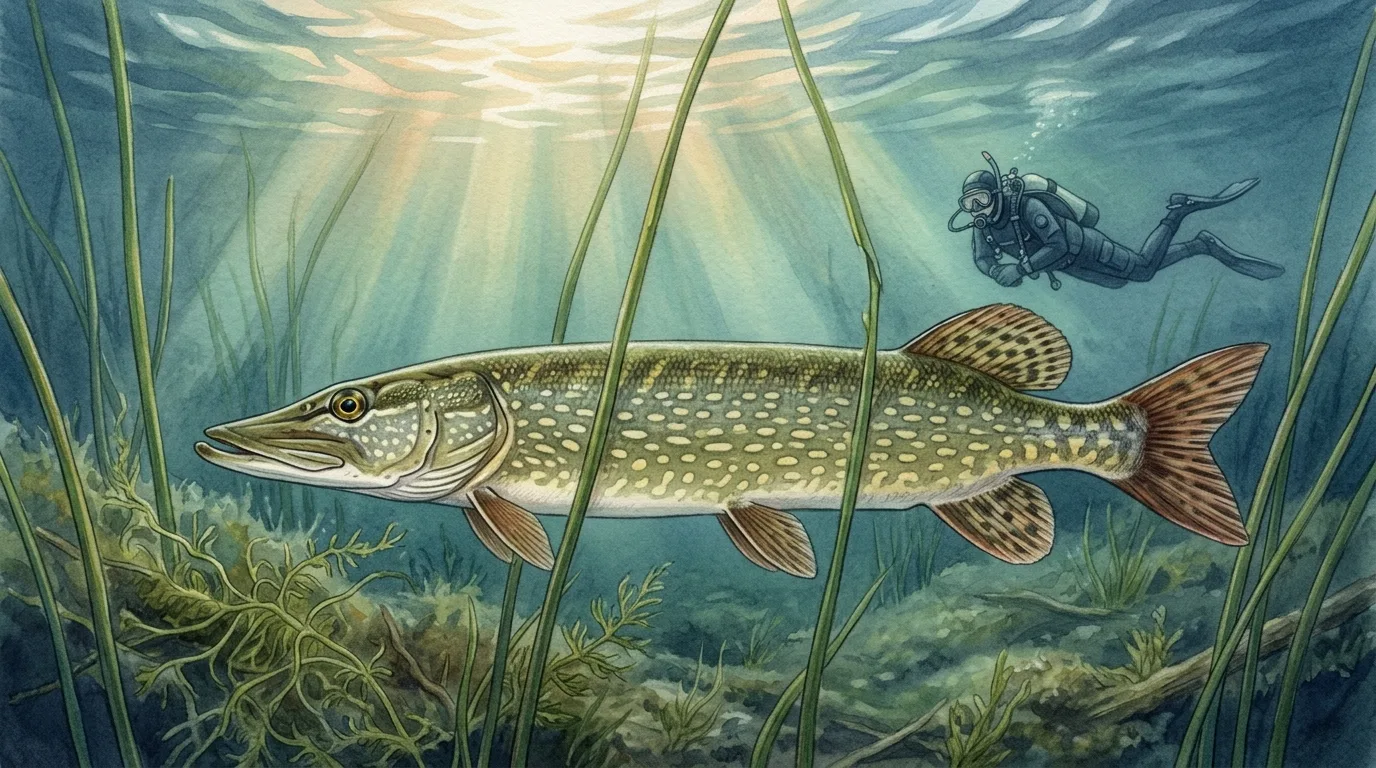
It hangs in the reeds so still that it is easy to mistake for a sunken stick. Only its golden eye gives away that the “stick” is watching everything around it. Let a careless roach swim past, and the pike bursts from cover in a fraction of a second. Divers know this sight from almost every Polish lake: a predator that does not chase its prey, but waits for it.
At a glance
- The northern pike (Esox lucius) is the only member of the pike family in Poland. Worldwide the genus Esox has seven species, including two European ones described only in 2011 and 2014123.
- It is a classic ambush predator: it spends most of its time motionless and strikes with a violent lunge, in which mean peak acceleration measured in the laboratory exceeded 120 m/s²4.
- It spawns very early, just after the ice melts, in vegetated shallows and on flooded meadows. Draining meadows and straightening rivers deprive it of spawning grounds56.
- Females grow faster, live longer and are markedly larger than males. Exceptional fish exceed 130 cm57.
- In Polish inland waters the minimum size is 45 cm and the closed season runs from 1 January to 30 April. Angling association (PZW) rules are usually stricter89.
One species in Poland, seven worldwide
The pike belongs to the family Esocidae and the order Esociformes. Only one species of the family lives in Poland: the northern pike, which is found all around the northern hemisphere in the fresh waters of Europe, Asia and North America7.
Its closest relatives are mostly American: the huge muskellunge (Esox masquinongy, up to 183 cm), the chain pickerel (E. niger) and the small redfin and grass pickerel (E. americanus). The Amur pike (E. reichertii) lives in the Amur basin1. Curiously, Europe has “gained” two new species in recent years. In 2011 the southern pike from Italy was described by two teams independently, as Esox cisalpinus and as E. flaviae3. In 2014 the Aquitanian pike, Esox aquitanicus, was described from south-western France2. Both had been taken for ordinary pike for centuries; it took genetic studies and careful measurements to tell them apart.
| Species | Range | Largest recorded length |
|---|---|---|
| northern pike (E. lucius) | Europe, Asia, North America | 150 cm |
| muskellunge (E. masquinongy) | North America | 183 cm |
| Amur pike (E. reichertii) | East Asia | 115 cm |
| chain pickerel (E. niger) | North America | 99 cm |
| southern pike (E. cisalpinus) | Italy and neighbouring areas | 103 cm |
| Aquitanian pike (E. aquitanicus) | south-western France | c. 42 cm (standard length) |
| redfin/grass pickerel (E. americanus) | North America | c. 39 cm |
Data: FishBase.1
What it looks like and how to recognise it
A pike is hard to confuse with any other fish. It has an elongated, almost cylindrical, torpedo-shaped body, with the dorsal and anal fins set far back, just in front of the tail fin. Together these three fins work like a paddle at take-off. The head makes up about a quarter of the body length, and the flattened snout resembles a duck’s bill; the lower jaw protrudes slightly5.
Its colouring is a masterpiece of camouflage: the back and flanks are olive-green or brownish, covered with rows of pale, bean-shaped spots, and the belly is creamy white. Young pike have vertical bars instead of spots, which melt perfectly into a background of reed stems5.
The inside of the mouth is a real trap. Large, sharp fangs line the jaws, and the roof of the mouth is covered with hundreds of small, backward-pointing teeth that let prey slide down the throat but stop it from backing out. Rows of lateral-line pores are visible on the head, including the underside of the lower jaw5. With them the pike “hears” water vibrations made by a swimming fish even when it cannot see it. Large eyes set high on the head let it look forwards and slightly upwards, which is exactly where prey usually comes from.
Where it lives
Pike like calm, weedy water: lake bays with reeds, water lilies and pondweeds, oxbow lakes, slow stretches of rivers, reservoirs and gravel pits. They usually stay in shallow water, between 1 and 5 metres, although they have been recorded down to 30 m7. Vegetation is the key. It gives adults cover, gives young fish shelter from predators (including older pike), and gives the eggs something to stick to5.
Few people know that pike also live in the sea. In the Baltic, especially in its low-salinity bays, they occur in brackish water. Some Baltic pike migrate to rivers and coastal wetlands to spawn and then return to the sea to feed. Many of them return to the very stream where they hatched6. In the southern Baltic, however, the species lives at the limit of its salinity tolerance10.
In Polish coastal waters the pike is in a poor state today. For decades it was an important predator in the Bay of Puck, but drained meadows and pumping stations at the mouths of the Płutnica and Reda rivers cut it off from its spawning grounds. Scientists from the National Marine Fisheries Research Institute consider the local population practically extinct, sustained mainly by stocking1112. Efforts to rebuild it are under way, including experiments with eggs from German coastal pike that are able to spawn in brackish water. So far the results are promising but uncertain13.
How it hunts and what it eats
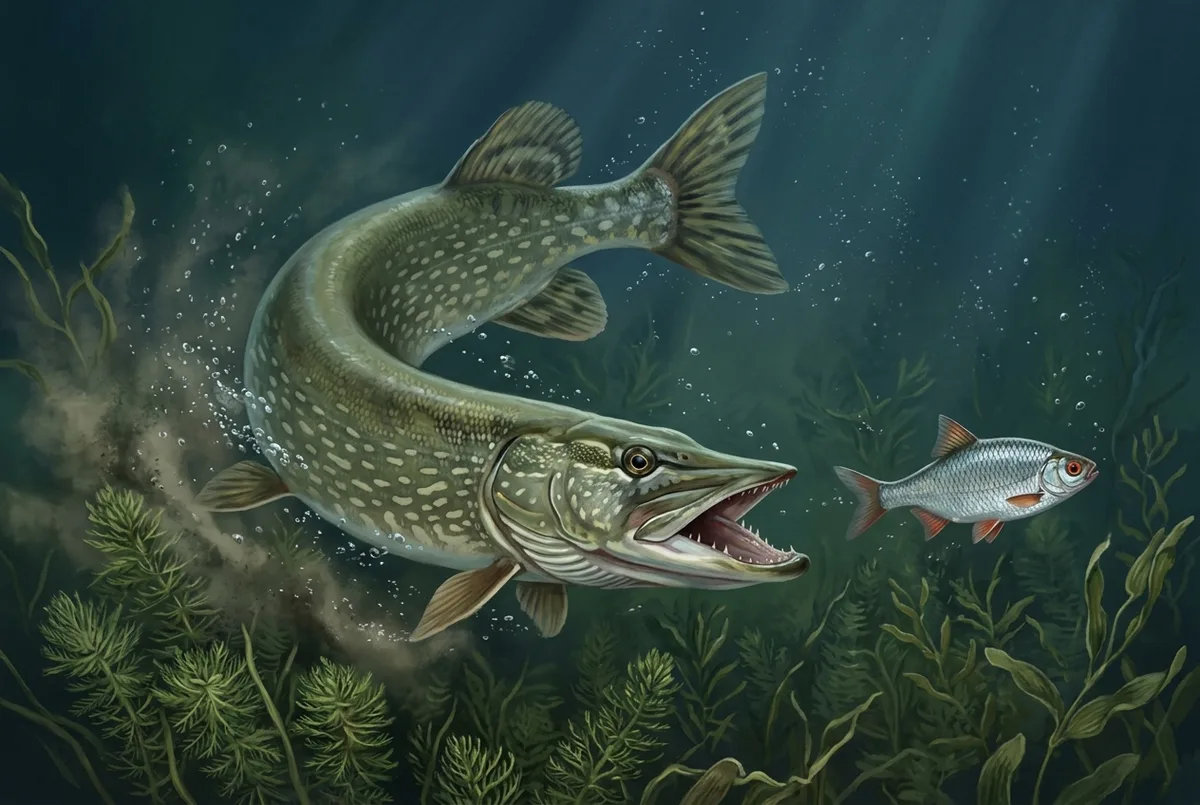
The pike is no long-distance swimmer. In one Canadian telemetry study, tagged fish were active only about 20% of the time5. The rest they spend motionless, stationed at the edge of the reeds, under a fallen tree or next to a clump of plants. When prey comes within range, the strike follows.
This strike is the so-called S-start: the body bends into an S and then straightens like a spring, while the rear-set fins deliver a powerful push. In a classic 1990 study, the mean peak acceleration of pike was about 120 m/s², more than twice that of rainbow trout, and the highest speed recorded reached 7 m/s4. Later research showed that although a feeding strike and an escape look similar, the brain controls them differently. The strike is slightly slower and more “considered”, because the fish adjusts its direction as it goes14.
A pike seizes its prey crosswise, holds it with its teeth, turns it and swallows it head first. It feeds mainly on fish, but it does not turn down frogs or crayfish, and large individuals even take waterfowl chicks and small mammals. The optimum prey is one third to one half of the pike’s own length5. It is also a cannibal: when other food is short, larger pike eat smaller ones, and among fry cannibalism appears within the first weeks of life. Researchers regard it as a natural regulator of population size5.
Reproduction: spawning almost under the ice
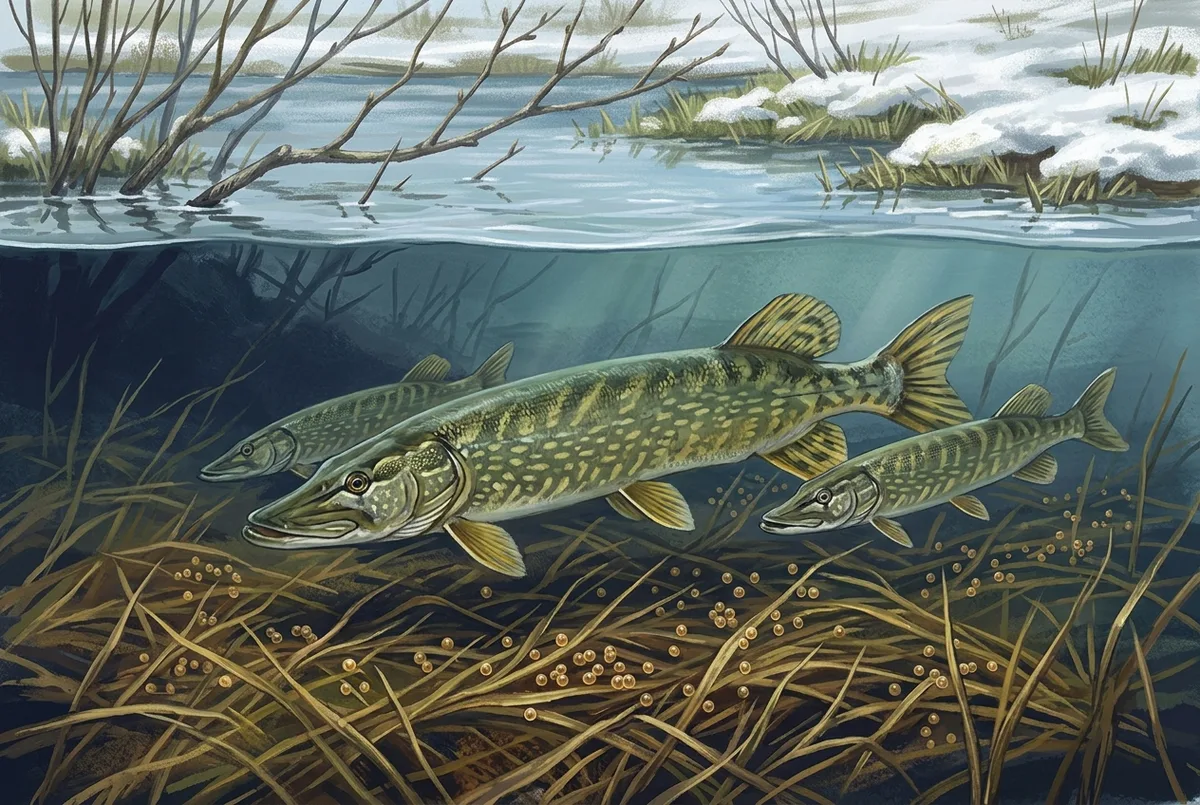
The pike is one of the first fish to spawn. It does so in early spring, shortly after the ice melts5; in Poland usually in March and April. Males arrive at the spawning grounds earlier than females6. A large female is usually accompanied by several smaller males, and spawning can last several days.
The spawning grounds are vegetated shallows, ideally flooded meadows and sedge beds along rivers and lakes. The female releases her eggs in small batches of a few dozen, scattering them over submerged grass. The sticky eggs adhere to the plants75. The average fecundity given in the literature is about 32,000 eggs per female, but large females lay far more5. After about two weeks, larvae 6–8 mm long hatch. For the next few days they hang on the plants, attached by a special gland on the head, living on their yolk sac5.
This is where the pike’s biggest problem lies in a landscape reshaped by people. Flooded meadows warm up quickly and teem with plankton, making them an ideal nursery for fry6. Drainage ditches, embankments, weirs and river regulation, however, make spring floodwaters disappear, or let the water drop before the young can swim out. The strength of a year class depends heavily on high, stable water levels while the fry develop5. That is why pike are widely stocked. Researchers stress, however, that restoring wetlands is often more effective, and that stocking should use fish from the same region, because local populations can be genetically distinct and adapted to local conditions6.
Growth, age and records
A young pike grows remarkably fast. In good conditions it can reach about 15 cm by the end of its first summer5. Males usually mature at 2 years old and females a year later, although size matters more than age here5. Females grow faster, live longer and are bigger than males, which is why nearly all really big pike are females5. According to FishBase, typical length is about 40 cm in males and 55 cm in females, while the largest recorded females reached 150 cm and 28.4 kg7. Pike can live up to 30 years, but in most populations fish older than 7 are rare57.
The official Polish record, kept by the monthly Wiadomości Wędkarskie, belongs to Marian Polawczyk: his 1970 pike weighed 20.8 kg and measured 130 cm. In May 2026 a 133 cm pike from Lake Solina made headlines, but the magazine did not accept it as a record, because instead of original material it received only video fragments and copies of photos without metadata15. The International Game Fish Association (IGFA) all-tackle world record is 25 kg, caught by Lothar Louis on 16 October 1986 at Lake Grefeern in Germany16.
Curiosities and the pike in culture
- In the Finnish Kalevala, the sage Väinämöinen kills a giant pike and builds the first kantele, Finland’s national instrument, from its jawbone17.
- Newly hatched pike larvae do not swim; they hang stuck to plants like tiny pins5.
- In winter the pike changes its rhythm: in summer it hunts mainly at dawn and dusk, while in winter it is more active during the day5. That is why ice anglers know it well too.
Myths and legends
“Pike aren’t biting because they’re changing their teeth.” This is one of the most persistent angling beliefs. Pike do replace their teeth throughout life, like most bony fish, but they do so gradually, tooth by tooth, not all at once at a particular time of year18. So there is no “toothless season”. Poor fishing has ordinary causes: water temperature, plenty of natural food, or the time of day.
The Emperor’s pike of Kaiserslautern and Heilbronn. According to legend, on 6 November 1497 a pike 19 feet long (about 5.7 m) and weighing 350 pounds was caught in the Kaiserwoog pond at Kaiserslautern. Around its neck it supposedly wore a gilded copper ring with a Greek inscription stating that Emperor Frederick II had put the fish into the pond with his own hand in 1230, which would have made it 267 years old. The same story was told of a lake near Heilbronn; in the 16th century it was recorded by the Swiss naturalist Conrad Gessner. For centuries it was repeated in ichthyology books as fact. Only in the 19th century did Cuvier and Valenciennes dismiss it as a legend. A skeleton shown in Mannheim as the remains of the Emperor’s pike later turned out to be a whale skeleton19. The facts are less spectacular: the largest reliably measured pike are about 1.5 m long, and an age of 30 is already exceptional7.
“A pike will eat anything and everything.” It is voracious, but it is not a pest. It mainly eats whatever is easiest to catch in a given place, usually abundant small fish5. As an apex predator it keeps their numbers in check, and researchers link the decline of pike along the Swedish Baltic coast to changes across the whole coastal ecosystem6.
The rules: minimum size and closed season
Fishing in Polish inland waters is currently governed by the Regulation of the Minister of Agriculture and Rural Development of 12 July 2023 (Journal of Laws 2023, item 1373), which replaced the earlier regulation of 2001. Marine waters are covered by a separate regulation of 27 December 2023 (Journal of Laws 2023, item 2816)820.
| Inland waters | Internal marine waters | |
|---|---|---|
| Minimum size | 45 cm | 50 cm |
| Closed season | 1 January – 30 April | 1 January – 15 May in the Gulf of Gdańsk; 1 January – 30 April in waters west of 15°23′14″ E (including the Szczecin Lagoon) and on Lake Dąbie |
| Daily bag limit | not set by the regulation | 2 fish in total together with zander |
Length is measured from the tip of the closed mouth to the end of the longest ray of the tail fin8.
The regulation is only the minimum. Whoever holds the fishing rights, such as a regional PZW branch, can set stricter rules in its permit, and usually does. For example, in the Katowice PZW district in 2026 the minimum size for pike is 50 cm, some reservoirs have a slot limit (fish under 50 cm and over 90 cm are protected), some waters have a closed season extended to 31 May, and the daily bag limit is 2 pike and zander in total9. Always check the rules for the specific water before you go. Minimum sizes and closed seasons also apply to spearfishing, which requires an underwater fishing card8; in marine waters spearguns may only be used without breathing apparatus20.
Meeting a pike underwater
For a diver, a pike is one of the most rewarding encounters in Polish fresh water. We most often see it in the vegetation zone a few metres down: at the edge of the reeds, in underwater meadows, by sunken trunks and branches, around jetties. It hangs motionless, sometimes at an angle, with its pectoral fins barely moving. Because stillness is its strategy, it often lets you come closer than you would expect of a wild fish. When it decides that is enough, it leaves with a single flick of its tail.
A few rules to make the encounter a good one for both sides:
- Approach slowly, low and from the side, not head-on. Good buoyancy and trim matter more here than camera gear. Every fin kick that touches the bottom raises a cloud of silt that ends the observation.
- Don’t touch and don’t feed. The mucus on its skin protects the fish from infection. Feeding teaches a predator bad habits, and with a pike it is simply risky for your fingers.
- Don’t chase a fish that swims away. If it left, it felt threatened. Next time, stop further off.
- Avoid spawning grounds in spring. In March and April, shallow weedy bays and flooded meadows are where pike spawn. Don’t enter them, don’t wade and don’t stir up the bottom, because eggs stuck to plants are easily lost. On many waters spawning grounds are also designated protection zones.
- When taking photos, light from the side and take several shots rather than one from very close. A pike is so well camouflaged that it looks best in profile, against plants or against the bright water above it. Don’t shine a torch straight into its eyes for long.
And when you do meet a pike, stop for a moment and simply watch. Few fish show so clearly that in nature patience can beat speed.
Notes
Footnotes
-
Froese R, Pauly D (eds). Species list for the genus Esox. FishBase. https://fishbase.se/identification/SpeciesList.php?genus=Esox. ↩ ↩2 ↩3
-
Denys GPJ, Dettai A, Persat H, Hautecœur M, Keith P. Morphological and molecular evidence of three species of pikes Esox spp. (Actinopterygii, Esocidae) in France, including the description of a new species. Comptes Rendus Biologies. 2014;337(9):521–534. doi:10.1016/j.crvi.2014.07.002. ↩ ↩2
-
Lucentini L, Puletti ME, Ricciolini C, et al. Molecular and phenotypic evidence of a new species of genus Esox (Esocidae, Esociformes, Actinopterygii): the southern pike, Esox flaviae. PLoS ONE. 2011;6(12):e25218. doi:10.1371/journal.pone.0025218. The same species was described in parallel by Bianco and Delmastro (2011) as Esox cisalpinus. ↩ ↩2
-
Harper DG, Blake RW. Fast-start performance of rainbow trout Salmo gairdneri and northern pike Esox lucius. Journal of Experimental Biology. 1990;150(1):321–342. doi:10.1242/jeb.150.1.321. ↩ ↩2
-
Harvey B. A Biological Synopsis of Northern Pike (Esox lucius). Canadian Manuscript Report of Fisheries and Aquatic Sciences 2885. Fisheries and Oceans Canada; 2009. https://waves-vagues.dfo-mpo.gc.ca/library-bibliotheque/337844.pdf. ↩ ↩2 ↩3 ↩4 ↩5 ↩6 ↩7 ↩8 ↩9 ↩10 ↩11 ↩12 ↩13 ↩14 ↩15 ↩16 ↩17 ↩18 ↩19 ↩20 ↩21
-
Larsson P, Tibblin P, Koch-Schmidt P, Engstedt O, Nilsson J, Nordahl O, Forsman A. Ecology, evolution, and management strategies of northern pike populations in the Baltic Sea. Ambio. 2015;44(Suppl 3):451–461. doi:10.1007/s13280-015-0664-6. ↩ ↩2 ↩3 ↩4 ↩5 ↩6
-
Froese R, Pauly D (eds). Esox lucius Linnaeus, 1758, Northern pike. FishBase, version 2025/2026. https://www.fishbase.se/summary/Esox-lucius.html. ↩ ↩2 ↩3 ↩4 ↩5 ↩6 ↩7
-
Regulation of the Minister of Agriculture and Rural Development of 12 July 2023 on detailed conditions for the protection and fishing of fish in inland surface waters (in Polish). Journal of Laws (Dz.U.) 2023, item 1373, §§ 6–7. https://isap.sejm.gov.pl/isap.nsf/DocDetails.xsp?id=WDU20230001373. ↩ ↩2 ↩3 ↩4
-
Katowice District of the Polish Angling Association (PZW). Detailed conditions for recreational fishing in the district’s public waters in 2026 (dated 25.09.2025, in Polish). Reprinted by PZW Club No. 68 Zebrzydowice. https://zebrzydowice.pzw.pl/strefa-wedkarza/zasady-wedkowania-w-okregu-katowice-od-2026-r. ↩ ↩2
-
Möller S, Winkler HM, Klügel A, Richter S. Using otolith microchemical analysis to investigate the importance of brackish bays for pike (Esox lucius Linnaeus, 1758) reproduction in the southern Baltic Sea. Ecology of Freshwater Fish. 2019;28:602–610. doi:10.1111/eff.12478. ↩
-
Psuty I, Zaporowski R, Gaweł WB. Goodbye to northern pike (Esox lucius) in the Polish southern Baltic? Fisheries Research. 2023;258:106549. doi:10.1016/j.fishres.2022.106549. ↩
-
National Marine Fisheries Research Institute (MIR-PIB). PIKE project: project goal. https://pike.mir.gdynia.pl/goal.html. ↩
-
Fey DP, Greszkiewicz M, Lejk AM, Zimak M, Białowąs M. Assessing the potential for introducing resident brackish-water pike (Esox lucius) to restore depleted Baltic Sea populations. Fisheries & Aquatic Life. 2025;33(4). doi:10.2478/aopf-2025-0019. ↩
-
Schriefer JE, Hale ME. Strikes and startles of northern pike (Esox lucius): a comparison of muscle activity and kinematics between S-start behaviors. Journal of Experimental Biology. 2004;207(3):535–544. doi:10.1242/jeb.00789. ↩
-
Rekord pisany na wodzie. Wątpliwości wokół ogromnego szczupaka [A record written on water: doubts about a huge pike]. Polsat News, 19 May 2026. https://www.polsatnews.pl/wiadomosc/2026-05-19/rekord-pisany-na-wodzie-watpliwosci-wokol-ogromnego-szczupaka/. ↩
-
International Game Fish Association. 12 of the largest northern pike in IGFA world record history. IGFA, 19 May 2026. https://igfa.org/2026/05/19/12-of-the-largest-northern-pike-in-igfa-world-record-history/. ↩
-
Lönnrot E. Kalevala. Rune XL (“Birth of the Harp”), trans. J.M. Crawford. Project Gutenberg. https://www.gutenberg.org/ebooks/5186. ↩
-
Huysseune A, Witten PE. Continuous tooth replacement: what can teleost fish teach us? Biological Reviews. 2024;99(3):797–819. doi:10.1111/brv.13045. ↩
-
Sage vom Hecht im Kaiserwoog. German Wikipedia; the article draws on, among others: C. Gessner, Historiae animalium liber IIII, 1558; M. Freher, Origines Palatinae, 1612; G. Cuvier and A. Valenciennes, 1846; G. Hartmann, Mannheimer Geschichtsblätter, 1927. https://de.wikipedia.org/wiki/Sage_vom_Hecht_im_Kaiserwoog. ↩
-
Regulation of the Minister of Agriculture and Rural Development of 27 December 2023 on minimum sizes and closed seasons for marine organisms caught in recreational fishing and on detailed conditions for recreational fishing (in Polish). Journal of Laws (Dz.U.) 2023, item 2816, §§ 2, 3, 11. https://isap.sejm.gov.pl/isap.nsf/DocDetails.xsp?id=WDU20230002816. ↩ ↩2