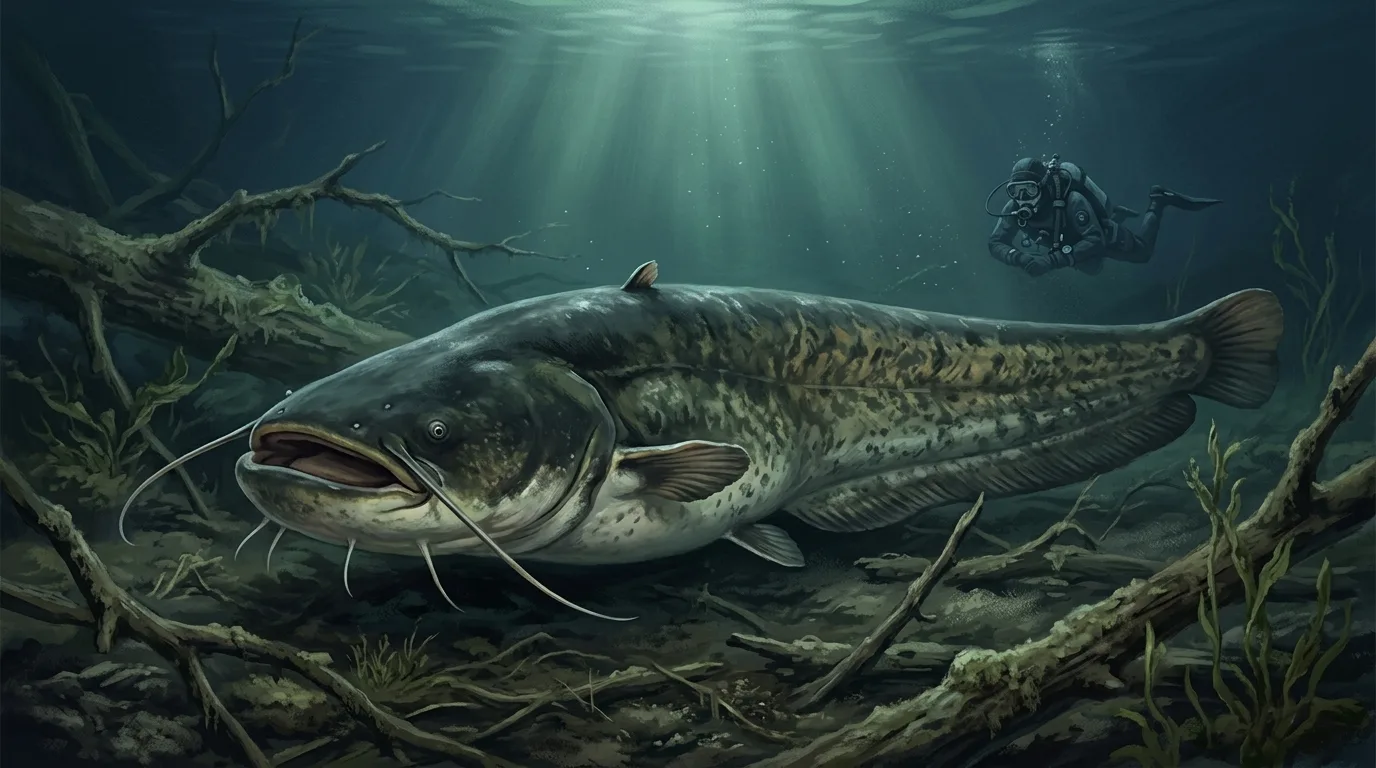
At the end of July 2021, three anglers pulled a wels catfish 267 cm long and weighing 104 kg out of the Vistula at Drogomyśl, a dozen or so kilometres from our foundation’s home1. The fish did not survive the catch, so it never became a record. Four years later, in October 2025, a wels measuring 292 cm was caught and released on the Rybnik Reservoir2. The wels catfish is Europe’s largest freshwater fish, and the muddy beds of our rivers, lakes and flooded pits are also home to its distant, much smaller cousins from across the Atlantic. Here we explain how to tell them apart, how much truth there is in stories of “man-eating catfish”, and how to behave when a diver meets the whiskered giant.
In brief
- Only one catfish is native to Poland: the wels catfish (Silurus glanis), also called the European catfish. Documented specimens exceed 2.7 m in length and 130 kg in weight3.
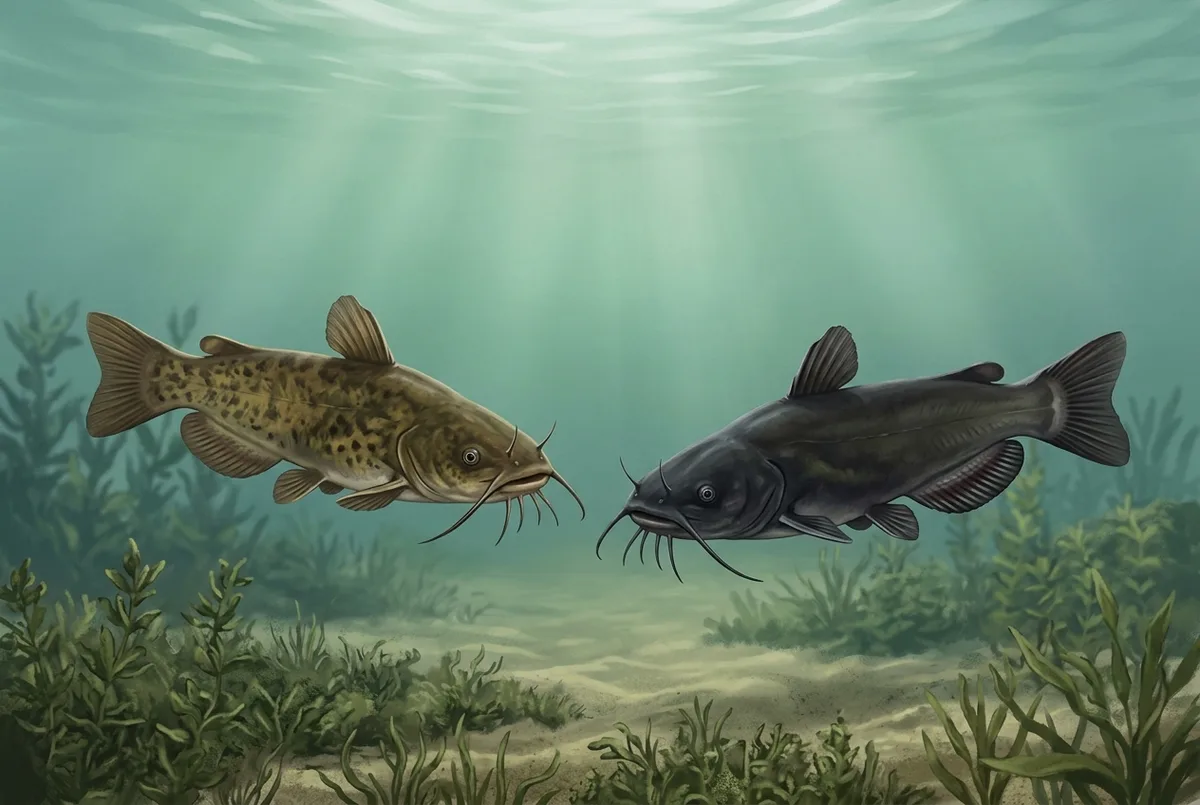
- The brown bullhead and the black bullhead are alien fish from North America, very similar and often confused. Both are legally designated invasive species; if caught, they must be killed and may not be released45.
- The African catfish is farmed in Poland in heated water, but according to the register of alien species it does not live in the wild6.
- The wels hunts mainly at night and can find prey purely by following the trail of eddies a swimming fish leaves behind7. In France, some wels have learned to grab pigeons from the shore8.
- In Poland the minimum landing size for wels is 70 cm and the closed season runs from 1 January to 31 May4.
- Attacks on people are extremely rare. The best-documented case, in Bavaria in 2025, was attributed to nest defence, so we give spawning sites a wide berth.
Catfish and bullheads: who is who
All the fish described here are catfishes (order Siluriformes) from three different families. What they share is a scaleless body and barbels around the mouth.
| Species | Origin | Barbels | Typical size | Status in Poland |
|---|---|---|---|---|
| Wels catfish (Silurus glanis) | native | 6 (2 long on the upper jaw, 4 short under the chin) | usually about 1 m, exceptionally over 2.5 m | game fish; minimum size and closed season |
| Brown bullhead (Ameiurus nebulosus) | North America | 8 | usually from a dozen to a few dozen cm | invasive alien species of concern for Poland |
| Black bullhead (Ameiurus melas) | North America | 8 | usually from a dozen to a few dozen cm | invasive alien species of Union concern |
| African catfish (Clarias gariepinus) | Africa, Middle East | 8 | in the wild usually up to about 90 cm, at most 170 cm | farms only |
American bullheads: an identification problem
For decades it was assumed that only one bullhead had reached Poland from America: the brown bullhead. In 2010 a Polish-Slovak team of ichthyologists described the first Polish record of the black bullhead9. The same year, the same researchers found a black bullhead specimen in the collection of the Museum and Institute of Zoology of the Polish Academy of Sciences in Warsaw. They took this as strong evidence that both species arrived in Poland together, as early as the end of the 19th century, and called for checking which bullhead actually lives in individual waters across the country10.
They are hard to tell apart, especially when young. Researchers look above all at three features11:
- anal fin: in the black bullhead the membranes between the rays are dark, almost black, while the rays themselves are clearly paler;
- pectoral fin spine: in the black bullhead the teeth on the rear edge are small or absent, in the brown bullhead they are well marked;
- gill rakers on the first gill arch: the black bullhead has more of them (in a Lithuanian study always at least 18).
These features are variable and partly overlap, and hybrids also occur in Europe, so only a DNA test gives certainty11. In practice, though, it makes no difference. The black bullhead is on the EU list of invasive alien species and the brown bullhead on the national list5, and the fishing regulation requires anglers to kill any specimens of either species immediately and forbids releasing them into any water4. It is also forbidden to move them to other waters, keep them alive or breed them12.
African catfish: a farmed fish
Clarias gariepinus was brought to Poland in 1989 for aquaculture6. In Africa it usually grows to about 90 cm, exceptionally to 170 cm13. It can breathe atmospheric air and move between water bodies6. There are stories of African catfish in warm-water outflows from power stations, but we found no documented record of the species in open Polish waters. The alien species register of the Institute of Nature Conservation of the Polish Academy of Sciences states that in Poland it currently occurs only on farms and is a non-invasive species6. According to a review by the U.S. Fish and Wildlife Service, African catfish have occasionally escaped from European farms but have not become established anywhere in Europe, and their embryos die at 15°C14. A Polish winter is a death sentence for them.
Anatomy of the wels catfish
The wels has a broad, flattened head, an enormous mouth with bands of small, brush-like teeth, and very small eyes. Two long, mobile barbels grow from the upper jaw, with four shorter ones under the chin. The dorsal fin is tiny, whereas the anal fin runs along almost half of the body, right up to the rounded tail fin. The skin has no scales and is covered with a thick layer of mucus. The back can be almost black, the flanks are marbled olive or yellowish-brown, and the belly is pale with dark blotches1516.
Small eyes do not mean poor senses. As in other catfishes, the barbels are used for taste and touch, and the lateral line picks up the slightest water movements. In a laboratory experiment by German researchers, wels in complete darkness followed swimming guppies, retracing their path in three dimensions from the eddy trail alone. Wakes up to 10 seconds old led them over distances of up to 55 prey body lengths7. The wels hears well (like carp, it has a Weberian apparatus linking the swim bladder to the inner ear), and its hearing becomes sharper as the water warms17.
Where it lives
The natural range of the wels stretches from the Baltic drainage to the Black Sea and Caspian basins18. In Poland it is a native fish, found in large lowland rivers, oxbow lakes, dam reservoirs, lakes and flooded pits. It likes deep, calm water and hiding places: fallen trees, undercut banks, holes in the bed. It does best in warm water, with a physiological optimum of about 25–27°C3. That is why it grows so well in reservoirs heated by power stations, such as the Rybnik Reservoir, where the water does not drop below 15°C from April to October2.
Wels are fairly sedentary. In the Meuse, 89% of 20 fish tracked by telemetry over several months never left the 1.5 km stretch of river where they had been tagged3. In winter they are inactive and sit out the cold in deep holes, dens and crevices in the bed19. Activity usually peaks at night, although this varies with the season3.
What it eats and how it hunts
Young wels eat invertebrates and small fish; adults eat mainly fish, but also crayfish, frogs, waterbirds and small mammals1820. The wels swallows its prey whole.
Its most famous behaviour was described in 2012 by French researchers on the River Tarn in the historic centre of Albi. The catfish approached a gravel islet where pigeons drank and preened, then lunged onto the shore, seized a bird and slid back into the water. The scientists filmed 45 such attacks, 28% of which were successful. An attack usually lasted less than a second and never more than four, and in 40% of cases more than half of the fish’s body was out of the water. The catfish attacked only moving pigeons and ignored motionless ones. Only part of the population hunted on land, and stable isotope analysis showed that the share of birds in the diet varied greatly between individuals: negligible in some, a substantial part of the food in others8. The authors called them “freshwater killer whales”, because orcas hunt seals on beaches in a similar way.
In France, wels also lie in wait for migratory fish. In the fish pass at the Golfech dam on the Garonne in 2016, they ate 14 of 39 radio-tagged salmon, or 35%21.
Spawning: dad guards the nest
Wels spawn in spring and early summer, once the water has warmed to about 18–22°C19. The male chooses a shallow spot with roots or vegetation and prepares a nest of plant material. Depending on her size, the female lays between 30,000 and 300,000 eggs in it19. Then the male is left alone: he guards the nest, fans the eggs with his fins and drives off intruders until the larvae hatch after 2–3 days1916. Wels usually reach sexual maturity at a few years of age18.
Growth, age and records
A typical adult wels is about a metre long and weighs about 10 kg16. A 2018 scientific review gives the documented maximum as over 2.7 m and 130 kg3. Older literature and guides mention five-metre wels weighing 300 kg16, but these are historical accounts that no one has verified. Wels can live a very long time; the often-quoted upper limit is about 80 years19, although such an age is hard to confirm.
Angling records have been changing fast recently:
- Europe and the world (catch and release): in June 2023 the Italian angler Alessandro Biancardi caught a 285 cm wels in the Po, which was measured in front of witnesses and released22.
- Poland: in October 2025 Krzysztof Pyra and Adrian Gontarz caught a 292 cm wels on the Rybnik Reservoir during a spinning competition, longer than the Italian fish. It was returned to the water after measurement2.
- Earlier “Polish records” are reported differently: 259 cm and 105.5 kg (Rybnik Reservoir, 17 October 2017)15 or 260 cm and 102 kg (Rybnik Reservoir, 2018)1. The larger fish from the Vistula at Drogomyśl (267 cm, 104 kg, 30 July 2021) was not recognised because it did not survive1.
The wels outside its range
In Poland the wels is at home, but in Western and Southern Europe it is an alien species, and a very successful one. It reached Spain in 1974, when young wels were released into the Mequinenza reservoir on the Ebro. Today it lives in almost all the large rivers of the Iberian Peninsula, and in 2025 its reproduction was confirmed in the lower Guadalquivir basin, not far from Doñana National Park23. In Italy the first wels was recorded in 1957 in the River Adda; by the end of the 1960s a self-sustaining population lived in the Po24. In the lower Po basin the wels’s share of fish biomass rose from 6% to 62% between 1991 and 2009, and ten native species declined sharply or disappeared locally24. In France the first attempts in the 19th century failed; stocking with fish from the Danube from the 1960s onwards succeeded, and from there the wels spread to the Saône and the Rhône, among other rivers16. On the Ebro, predation by wels is considered one of the causes of the disappearance of the endemic barbel Luciobarbus graellsii3.
The picture is not clear-cut, though. In a review of 112 sites in France, a decline in fish species richness after the arrival of the wels was found at only 1.4% of them3. Much depends on whether the ecosystem had already been weakened.
In its native range, including Poland, the wels is an apex predator, part of the natural food web of large rivers and lakes. Big, old fish take decades to grow and cannot be replaced quickly, which is why more and more anglers release them.
Myths and facts
“Wels attack people.” Almost always a legend, but not always. In June 2025, at the Brombachsee lake in Bavaria, a wels about 2 m long and weighing about 90 kg bit five bathers near a floating platform within two hours. The injuries were minor, and police shot the fish. In early July another person was bitten in a different part of the lake. Experts attributed the behaviour to a male defending its nest during the spawning season25. The wels has no teeth for cutting or tearing; its small, brush-like teeth serve to hold prey, so a bite results in grazes and superficial wounds.
“A wels ate a dog.” The most famous story comes from Mönchengladbach in Germany. In autumn 2001, a wels named “Kuno” supposedly swallowed a dachshund puppy in the pond of the Volksgarten park. The account rested on a single eyewitness, there was no photograph, and the dog’s owner was never found26. A dead wels 162 cm long and weighing 29.5 kg, assumed to be Kuno, was found in the pond in 2003; it was mounted and placed in the cabinet of curiosities of the museum at Schloss Rheydt27. We found no other documented case of a wels swallowing a dog.
“Wels swallow divers at dams.” This is a popular urban legend for which we found no confirmed case. The largest documented wels weigh about 130 kg, and their gullet can take a fish, a duck or a pigeon, not a person.
Fishing rules
Fishing in Polish inland waters is governed by the Regulation of the Minister of Agriculture and Rural Development of 12 July 2023 on detailed conditions for the protection and fishing of fish in inland surface waters (Journal of Laws 2023, item 1373), in force since 27 July 20234:
- minimum landing size for wels: 70 cm; smaller fish must be released;
- closed season for wels: 1 January to 31 May;
- national rules set no daily bag limit for wels (a daily limit applies to eel, for example);
- brown bullhead and black bullhead: caught specimens must be killed immediately and may not be released either into the fishery where they were caught or into any other water; the same rules apply to, among others, the Chinese sleeper, the topmouth gudgeon and the Ponto-Caspian gobies.
This is the minimum. The angling regulations of Polish Angling Association (PZW) districts and other fishery managers may set larger minimum sizes, longer closed seasons or daily bag limits, so always check the rules for the specific water.
Meeting a wels underwater
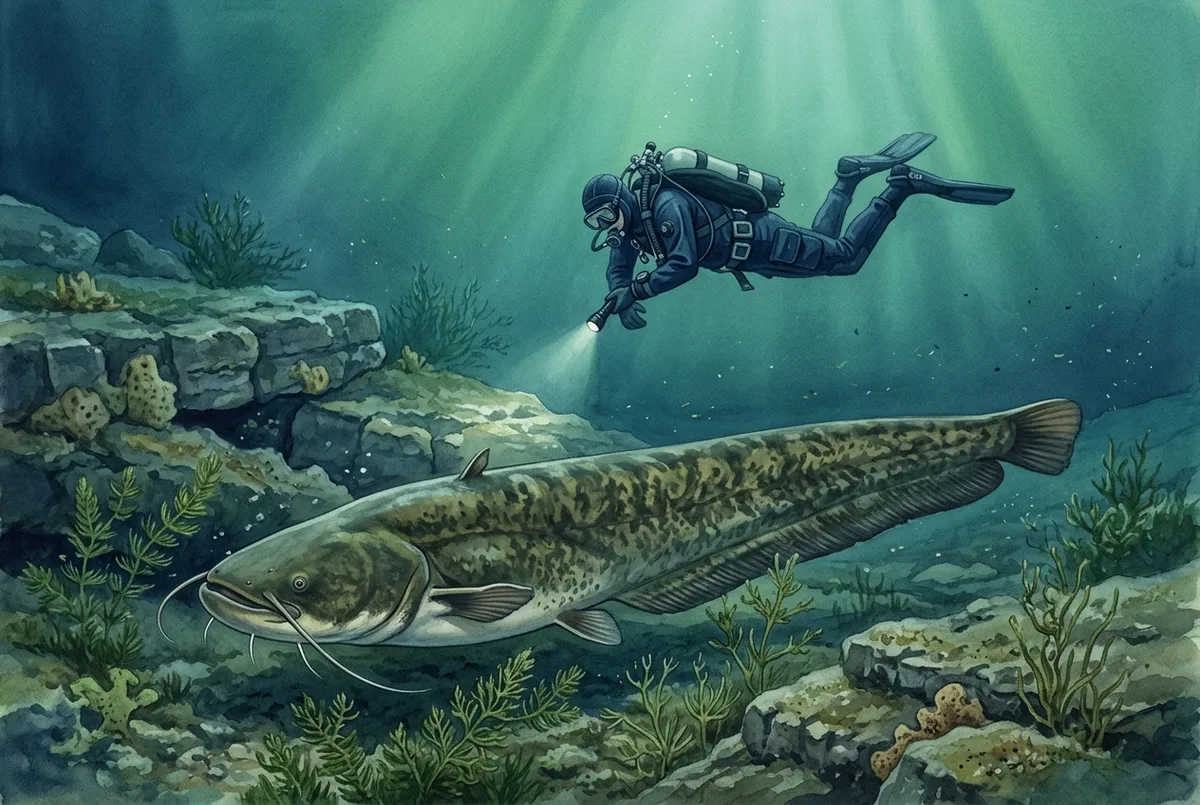
The wels is a dream encounter for many divers in Poland, but sightings are rare. Your chances are best in flooded quarries and gravel pits with plenty of vegetation and sunken wood, and in lakes with a muddy bed. In accounts from the Zakrzówek quarry in Kraków, divers described a “fairy-tale forest” of underwater plants that was home to the resident wels28. The best time is the warm months and night dives, because during the day wels usually lie motionless in their hiding places.
How to behave:
- Keep your distance of several metres and do not block the fish’s escape route. A cornered wels may bolt suddenly and strike with its tail.
- Do not touch. Mucus protects the wels’s skin against parasites and infections, and touching damages it. Do not feed fish.
- At night, point your torch at the bottom next to the fish, not straight at it. Diffused light lets you watch without dazzling or scaring it.
- Keep your trim and do not stir up silt. Wels live near the bottom, and a cloud of sediment ends the encounter for you and for the divers after you.
- Avoid spawning sites from May to July. A male guarding a nest drives off intruders, and disturbing him can lead to the loss of the eggs. If a wels keeps circling one spot in shallow, weedy water, swim away.
- Never release or move bullheads. If you see them in a water where they have not been recorded before, report it to the water’s manager or to the regional directorate for environmental protection.
Ideally, the wels should not even notice it was being watched.
Footnotes
-
Gigantyczny sum złowiony w Wiśle w Drogomyślu. Słodko-gorzki smak rekordu Polski [Giant wels caught in the Vistula at Drogomyśl: the bittersweet taste of a Polish record]. Beskidzka24.pl, 31 July 2021. https://beskidzka24.pl/gigantyczny-sum-zlowiony-w-wisle-w-drogomyslu-slodko-gorzki-smak-rekordu-polski/. ↩ ↩2 ↩3
-
Nowy rekord świata! Gigantyczny sum złowiony w Rybniku [New world record! Giant wels caught in Rybnik]. Rybnik city website (rybnik.eu), 20 October 2025. https://www.rybnik.eu/dla-mieszkancow/aktualnosci/aktualnosc/nowy-rekord-swiata-gigantyczny-sum-zlowiony-w-rybniku. ↩ ↩2 ↩3
-
Cucherousset J, Horky P, Slavík O, Ovidio M, Arlinghaus R, Boulêtreau S, Britton R, García-Berthou E, Santoul F. Ecology, behaviour and management of the European catfish. Rev Fish Biol Fisheries. 2018;28(1):177–190. doi:10.1007/s11160-017-9507-9. ↩ ↩2 ↩3 ↩4 ↩5 ↩6 ↩7
-
Rozporządzenie Ministra Rolnictwa i Rozwoju Wsi z dnia 12 lipca 2023 r. w sprawie szczegółowych warunków ochrony i połowu ryb w powierzchniowych wodach śródlądowych [Regulation of the Minister of Agriculture and Rural Development of 12 July 2023 on detailed conditions for the protection and fishing of fish in inland surface waters]. Dz.U. 2023 poz. 1373 (§ 6(1)(17), § 7(1)(12), § 8). https://isap.sejm.gov.pl/isap.nsf/DocDetails.xsp?id=WDU20230001373. ↩ ↩2 ↩3 ↩4
-
Rozporządzenie Rady Ministrów z dnia 9 grudnia 2022 r. w sprawie listy inwazyjnych gatunków obcych stwarzających zagrożenie dla Unii i listy inwazyjnych gatunków obcych stwarzających zagrożenie dla Polski… [Regulation of the Council of Ministers of 9 December 2022 on the list of invasive alien species of Union concern and the list of invasive alien species of concern for Poland…]. Dz.U. 2022 poz. 2649 (Annex 1: black bullhead; Annex 2: brown bullhead). https://isap.sejm.gov.pl/isap.nsf/DocDetails.xsp?id=WDU20220002649. ↩ ↩2
-
Institute of Nature Conservation, Polish Academy of Sciences. Alien species in Poland: Clarias gariepinus (Burchell, 1822). https://www.iop.krakow.pl/ias/gatunki/563. ↩ ↩2 ↩3 ↩4
-
Pohlmann K, Grasso FW, Breithaupt T. Tracking wakes: the nocturnal predatory strategy of piscivorous catfish. Proc Natl Acad Sci USA. 2001;98(13):7371–7374. doi:10.1073/pnas.121026298. ↩ ↩2
-
Cucherousset J, Boulêtreau S, Azémar F, Compin A, Guillaume M, Santoul F. “Freshwater killer whales”: beaching behavior of an alien fish to hunt land birds. PLoS ONE. 2012;7(12):e50840. doi:10.1371/journal.pone.0050840. ↩ ↩2
-
Nowak M, Koščo J, Popek W, Epler P. First record of the black bullhead Ameiurus melas (Teleostei: Ictaluridae) in Poland. J Fish Biol. 2010;76(6):1529–1532. doi:10.1111/j.1095-8649.2010.02601.x. ↩
-
Nowak M, Koščo J, Szczerbik P, Mierzwa D, Popek W. When did the black bullhead, Ameiurus melas (Teleostei: Ictaluridae), arrive in Poland? Arch Pol Fish. 2010;18(3):183–186. doi:10.2478/v10086-010-0021-0. ↩
-
Rakauskas V, Kaupinis A, Binkienė R, Baker NJ, Virbickas T, Kudlai O. First records of the black bullhead Ameiurus melas (Rafinesque, 1820) and its parasites in Lithuania. BioInvasions Records. 2025;14(4):929–943. https://www.reabic.net/journals/Bir/2025/4/BIR_2025_Rakauskas_etal.pdf. ↩ ↩2
-
Regional Directorate for Environmental Protection in Lublin. Inwazyjny gatunek obcy (IGO): sumik karłowaty. Co wolno, a czego nie wolno [Invasive alien species: brown bullhead. What is and is not allowed]. gov.pl. https://www.gov.pl/web/rdos-lublin/inwazyjny-gatunek-obcy-igo-sumik-karlowaty-co-wolno-a-czego-nie-wolno-. ↩
-
Froese R, Pauly D (eds). Clarias gariepinus (Burchell, 1822), North African catfish. FishBase. https://www.fishbase.se/summary/Clarias-gariepinus.html. ↩
-
U.S. Fish and Wildlife Service. North African catfish (Clarias gariepinus). Ecological Risk Screening Summary. 2022 (web version 25 August 2022). https://www.fws.gov/sites/default/files/documents/Ecological-Risk-Screening-Summary-North-African-Catfish.pdf. ↩
-
Sum pospolity [Wels catfish]. Wikipedia (Polish; accessed 30 September 2026). https://pl.wikipedia.org/wiki/Sum_pospolity. ↩ ↩2
-
Parlier E. Silurus glanis Linnaeus, 1758, silure glane. DORIS, FFESSM (French Federation for Underwater Studies and Sports), updated 9 September 2024. https://doris.ffessm.fr/Especes/Silurus-glanis-Silure-glane-364. ↩ ↩2 ↩3 ↩4 ↩5
-
Maiditsch IP, Ladich F. Effects of temperature on auditory sensitivity in eurythermal fishes: common carp Cyprinus carpio (family Cyprinidae) versus wels catfish Silurus glanis (family Siluridae). PLoS ONE. 2014;9(9):e108583. doi:10.1371/journal.pone.0108583. ↩
-
Froese R, Pauly D (eds). Silurus glanis Linnaeus, 1758, wels catfish. FishBase. https://www.fishbase.se/summary/Silurus-glanis.html. ↩ ↩2 ↩3
-
Fusaro A, Davidson A, Alame K, Gappy M, Baker E, Nunez G, Larson J, Conard W, Bartos A. Silurus glanis Linnaeus, 1758. U.S. Geological Survey, Nonindigenous Aquatic Species Database, Gainesville (FL). https://nas.er.usgs.gov/queries/greatlakes/FactSheet.aspx?Species_ID=3651&Potential=Y&Type=2. ↩ ↩2 ↩3 ↩4 ↩5
-
Copp GH, Britton JR, Cucherousset J, García-Berthou E, Kirk R, Peeler E, Stakėnas S. Voracious invader or benign feline? A review of the environmental biology of European catfish Silurus glanis in its native and introduced ranges. Fish Fish. 2009;10(3):252–282. doi:10.1111/j.1467-2979.2008.00321.x. ↩
-
Boulêtreau S, Gaillagot A, Carry L, Tétard S, De Oliveira E, Santoul F. Adult Atlantic salmon have a new freshwater predator. PLoS ONE. 2018;13(4):e0196046. doi:10.1371/journal.pone.0196046. ↩
-
Monster record breaking wels catfish caught in Italy. OutdoorHub, 21 June 2023. https://www.outdoorhub.com/news/2023/06/21/record-breaking-wels-catfish/. ↩
-
Estación Biológica de Doñana (CSIC). The Wels catfish thrives in the lower Guadalquivir and poses a threat to Doñana. 21 May 2025. https://www.ebd.csic.es/en/outreach/news/wels-catfish-thrives-lower-guadalquivir-and-poses-threat-donana. ↩
-
LIFE PREDATOR project (LIFE 101074458). The wels catfish, European catfish Silurus glanis L. https://lifepredator.eu/wels-catfish/. ↩ ↩2
-
Brombachsee: Fünf Badegäste von Riesenfisch gebissen – Wels erschossen [Brombachsee: five bathers bitten by giant fish – wels shot]. inFranken.de, June 2025. https://www.infranken.de/lk/weissenburg-gunzenhausen/blaulicht/riesenwels-brombachsee-angriff-polizei-badegaeste-erschossen-wasserwacht-musikfestival-sicherheitsrisiko-art-6230969; see also: Welsangriffe im Brombachsee 2025. Wikipedia (German). https://de.wikipedia.org/wiki/Welsangriffe_im_Brombachsee_2025. ↩
-
Volksgarten (Mönchengladbach). Wikipedia (German), section on “Killerwels Kuno” (accessed 30 September 2026). https://de.wikipedia.org/wiki/Volksgarten_(M%C3%B6nchengladbach). ↩
-
Städtisches Museum Schloss Rheydt. Wels “Kuno”, Mönchengladbach, 2003. museum-digital:deutschland. https://nat.museum-digital.de/object/1820194. ↩
-
Wesołowska M. Mekka nurków we współczesnej aglomeracji [A divers’ mecca in a modern city]. Underwater.pl, May 2013. https://www.underwater.pl/relacje-z-wypraw/nurkowanie-w-kamieniolomie-zakrzowek-krakow.html. ↩